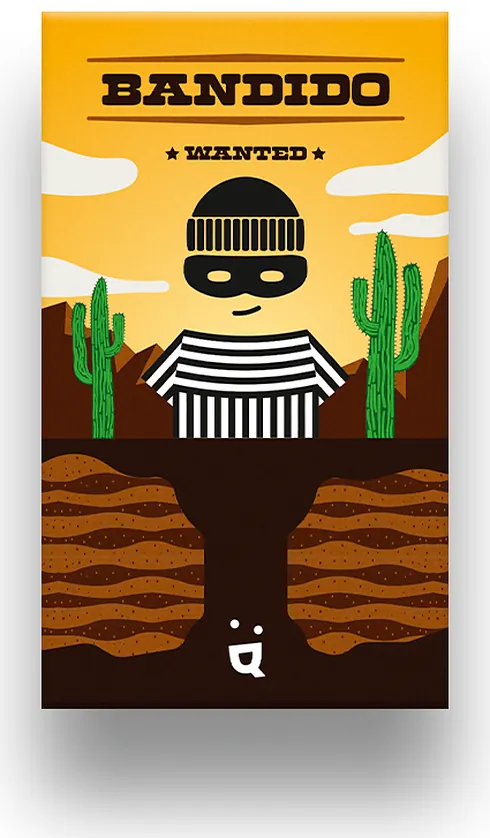
How it plays
The super card lies in the middle: Bandido in his cell, with five or six tunnels leading away from it, depending on the side. Everyone holds three long tunnel cards in their hand. Taking turns, players add a card and draw a new one; each card has to fit exactly along all its edges. Some cards branch the passage, others close it off with a dead end. Discussing moves is allowed, but showing or describing cards is not. If all the exits are sealed before the cards run out, the team wins.
What it can help develop
Every turn is a spatial task: does the card fit along all its edges, rotated or laid crosswise, and where does a gap appear that nothing will fit into any more? Planning ahead comes in too: the rules warn against cards that leave a tunnel permanently open. Children practise keeping count of the open exits and not laying a branch just because it fits (impulse control). Because the cards in hand stay hidden, players have to put their intentions into words.
Especially suitable for
- Children from age 6 who would rather play together than against each other
- Parent-and-child teams, or a solo game in a spare moment
- On holiday and when visiting: the box is pocket-sized
Less suitable for
- Players who want control rather than the luck of the draw
- Small tables: the tunnel network needs a lot of space
Our verdict
Bandido is a worthwhile choice for parent-and-child teams and children from age 6 who enjoy puzzling things out together, and also as a solo game in a spare moment. The rules can be explained in a few sentences, the box fits in any pocket, and according to the publisher, it is the best-selling game in its range. Its limitations are the luck factor when drawing cards, frustration after several defeats and the large amount of space the tunnel network needs.
Getting started
- Clarify the discussion rule beforehand: players may discuss their moves, but may neither show nor describe their cards.
- For more of a challenge, switch to the side of the super card with six exits; how much discussion is allowed also has a strong effect on the difficulty.
- Whenever possible, play cards that reduce the number of open exits; cards that make a tunnel impossible to close are risky.
In detail
Variants and player count
According to the rules, Bandido is intended for 1 to 4 people aged 6 to 99 and consists of 69 cards plus the super card. According to the publisher, a solo game is possible, although Board’s Eye View thinks it may be too easy. How hard the game is also depends on the super card: Board’s Eye View calls the side with five tunnels easy and the side with six harder. Casual Game Revolution stresses that even the easy side is challenging. Opinionated Gamers did not find Bandido too difficult with adults and therefore played without discussing their moves.
What reviewers say
Board Game Quest notes that Bandido can be explained in around 30 seconds and that the box is about the size of a deck of cards. Board Game Quest is critical of the fact that the game depends heavily on chance and needs a lot of table space. Meeple Mountain describes a light family game that is easy to learn and easy to take along. Geschichtenwolke finds Bandido quite hard to win and says players need to be able to cope with frustration. Brettspielbox praises the fact that the rules can be explained in three sentences, but mentions the high luck factor when drawing and the frustration after several defeats. Brettspielblog.ch describes the long cards with their dead ends and branches and calls the rules short and simple.
How it compares
Magic Maze Kids (from age 5, 2 to 4 people, about 15 to 25 minutes) calls for team coordination and planning ahead, like Bandido. Magic Maze Kids suits children who enjoy finding their way through the maze together, but is less of a challenge for older school-age children. Dorfromantik: The Board Game (from age 8, 1 to 6 people, about 30 to 60 minutes) shares spatial reasoning, planning ahead and team coordination with Bandido. Dorfromantik: The Board Game appeals to children who like to puzzle things out calmly and to parent-and-child pairs over many evenings, less so to those looking for speed or competition. Bandido is the more likely choice for a quarter of an hour in a spare moment, including solo, and for taking on holiday, because the box is pocket-sized.
Sources
Frequently asked questions
What age is Bandido suitable for?
Bandido is recommended from age 6. A child is ready when they can lay cards so that they fit spatially along all their edges and can cope with setbacks, because several defeats in a row can be frustrating. Anyone who likes to be in control of the game will be less happy, because drawing cards also influences the outcome.
How long does a game take and how many people can play?
A game takes about 15 minutes. The game is for 1 to 4 people, who play together against Bandido; a solo game is also possible. The team wins if all the exits are sealed before the draw pile runs out.
What skills can Bandido help develop?
The skills profile lists cooperation as well as logic and planning. Because nobody is allowed to show their cards, children have to say what they intend to do, and they practise keeping count of the open exits instead of immediately laying every branch that fits.
How much space does Bandido need?
The box is pocket-sized, but the tunnel network grows far beyond the box and needs a large table surface: the super card belongs in the middle of a large table. Things get cramped on small tables.