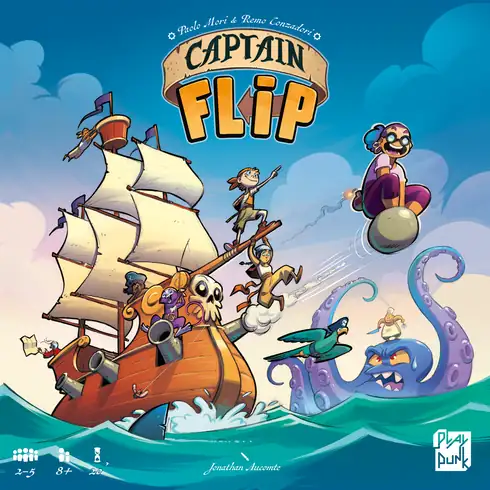
How it plays
As pirate captains, players recruit a crew: they draw one of 72 double-sided tiles from the bag and see only the top side. They keep that character or flip the tile and take the other side, with no going back. The tile goes on the lowest free space of a column on the player’s own ship. Some characters pay out coins immediately, others only at the end; full columns earn bonuses. Once someone has filled four of their five columns, the game ends after that round; whoever has the most coins wins.
What it can help develop
Every turn is a small decision under uncertainty: the visible character is only a partial fit, so is it better to flip the tile and take the unknown? Children practise estimating the odds and weighing a safe option against a better one. The character that pays five coins immediately calls for impulse control: anyone who already has two of them on board has to resist, because a third means defeat at the end. Planning comes in too: which column should I fill, and which characters in a row or column strengthen each other?
Especially suitable for
- Families with children from age 8
- Short games with an immediate rematch
- Children who like to push their luck
Less suitable for
- Players looking for a lot of interaction with others
- Strategy fans who prefer little randomness
Our verdict
Captain Flip is a worthwhile choice for families with children from age 8 who appreciate brisk games with an immediate rematch and enjoy taking a risk. Its strength: small decisions that keep the whole table in suspense. Its limitations are chance, the limited interaction between players and character abilities that have to be looked up at first.
Getting started
- Before the first turn, make clear that flipping is final: the reverse side is taken.
- Explain the character with the instant coins early on: three of them mean losing at the end, which shows nicely what weighing up options means.
- In larger groups, do not keep recounting the other players’ coins: it slows the pace.
In detail
Variants and player count
According to Spiel des Jahres, Captain Flip is a game by Paolo Mori and Remo Conzadori (PlayPunk) for 2 to 5 people from age 8. According to Wikipedia, the components include 72 double-sided character tiles (nine characters, 16 of each), three player aids, 10 double-sided boards showing a pirate ship and 58 coins. Players draw a tile from the bag, see only the top side and either place it or flip it over, with no going back. The game ends as soon as four of the five columns are full and the round has been played to the end; whoever is richest wins.
What reviewers say
According to Spiel des Jahres, Captain Flip was nominated for the Spiel des Jahres in 2024. The Spiel des Jahres jury calls it a very accessible tile-laying game with simple decisions that keep everyone on the edge of their seats; according to the jury, a rematch usually follows straight away. For the Swiss Gamers Award 2024, the results page lists Captain Flip ahead of Odin and Castle Combo in the Family category. On gamesweplay.de, Harald Schrapers describes a relaxed, fast game in which players hardly get annoyed by an unsuitable tile; according to Schrapers, the special functions have to be looked up on the help cards in the first round. Zatu describes quick turns and little direct confrontation; Meeple Mountain criticises the lack of interaction with the other players’ crews and mentions an element of memory in remembering the backs of flipped tiles.
How it compares
Port Royal (from age 8, 2 to 5 people, about 20 to 50 minutes) shares the age, the number of players and both skill areas with Captain Flip, impulse control as well as logic and planning. Ghost Blitz (from age 8, 2 to 8 people, about 20 minutes) has the same age and the same playing time as Captain Flip and shares the skill area of impulse control. Ghost Blitz also covers flexibility as well as perception and speed, while Captain Flip covers logic and planning. Captain Flip suits families with children from age 8 who like short games with an immediate rematch; anyone looking for a lot of interaction with the other players is less well served by it.
Sources
Frequently asked questions
What age is Captain Flip suitable for?
Captain Flip is recommended from age 8. A child is usually ready when they can live with a decision that cannot be undone and look up special abilities on the player aids. Anyone who prefers games they can plan will be less happy with it.
How long does a game take and how many people can play?
A game takes about 20 minutes. The game is for 2 to 5 people, who play against each other, each with their own ship; at the end, the largest fortune in coins wins. Because games are short, the rematch usually follows immediately.
What skills can Captain Flip help develop?
It can help develop impulse control as well as logic and planning. The character that brings in five coins immediately calls for restraint: three of them mean losing at the end. Players also plan which column to fill and which characters strengthen each other.
How much luck is there in Captain Flip?
A lot: the bag decides which tile comes next, and fortunes change quickly. Players do have a say when deciding whether to keep or flip; anyone who remembers the reverse sides they have seen has an easier time.