How it plays
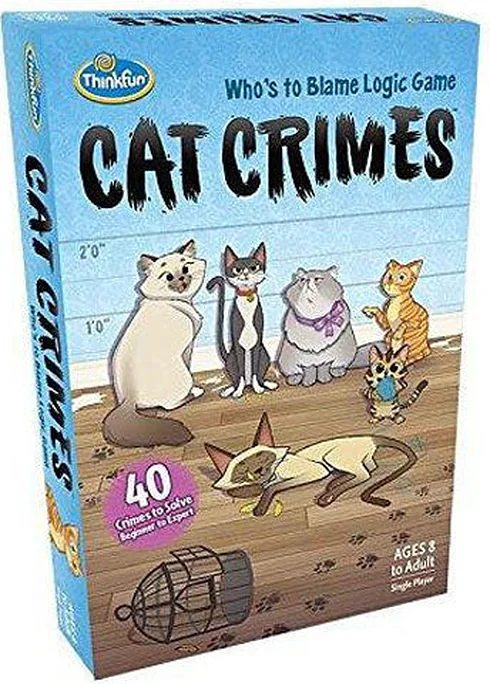
The player is looking after a neighbour’s six cats, and quite a few things get broken. In the edition reviewed, each of the 40 challenge cards (four levels) names a misdeed; its token goes on the board. Several clues reveal who was sitting in front of which piece of evidence, or next to or opposite whom; some cats are asleep upstairs and are ruled out. The player places the figures around the edge of the board until everything fits: whoever is sitting in front of the token did it, and the back of the card confirms this.
What it can help develop
At its core, this is deductive reasoning: each clue only narrows down the positions, and only the combination leads to the answer. The rules advise starting with clues that fix one position exactly and ruling out positions that contradict each other. On higher levels, a cat may fit two positions or is identified only by a feature such as a bow or a little bell; working memory keeps such open possibilities in mind. The change of perspective is a spatial challenge: “left” and “right” are seen from the cat’s point of view.
Especially suitable for
- Children from age 8 who enjoy puzzling things out and read confidently
- Newcomers to logic puzzles who want to ease into them gently
- A quiet activity to do alone, including on the go
Less suitable for
- Beginning readers: the clues have to be read
- Groups: it is designed for one person
Our verdict
Cat Crimes is a worthwhile choice for puzzle fans from age 8 who read confidently and enjoy working things out on their own, or in pairs if need be. Its strength: the easy cards provide a gentle start, after which the difficulty increases noticeably, and the figures allow players to try things out. Its limitations are the need to read, the focus on a single player and the lack of tokens for marking provisional assumptions.
Getting started
- Move the cats around the edge of the board, not just in your head, until all the clues fit: the figures are there to help you think things through.
- Before moving on to the higher levels, look at the features of the six cats together: there, a cat is sometimes described only by a detail such as its bow.
- Put clues about the same cat together and rule out positions that contradict each other.
In detail
Variants and player count
According to Ravensburger, Cat Crimes is a logic game from the ThinkFun brand for one person from age 8. The box contains challenge cards with solutions at four levels of difficulty, a board, six cat figures with stands and six event tokens. According to the German rules, the player is looking after the neighbour’s six cats; flowerpots have been broken, and the canary has disappeared from its cage. A 2018 ThinkFun press release mentions playing alone or together; Casual Game Revolution considers solving the puzzles with one or two other people feasible.
What reviewers say
PuzzleNation (2018, review copy) describes easy cards as a way in; according to PuzzleNation, on higher levels a cat sits in one of two places or is only identified by features such as a bow or a bell. According to PuzzleNation, players have to keep more information in their heads than with classic grid puzzles. Casual Game Revolution (2018, review copy) praises the presentation, the graded difficulty, the compact size and the figures, which help with thinking things through. According to Casual Game Revolution, early puzzles are easy for adults and late ones really hard; in its view, additional markers for noting assumptions would be helpful. Puzzle Prime (2021) calls it best for school-age children; according to Puzzle Prime, adults can join in, and the figures make it more entertaining than solving puzzles with pen and paper.
How it compares
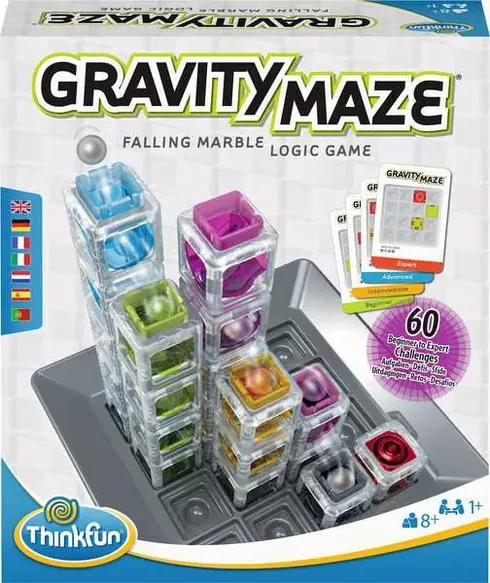
Gravity Maze (from age 8, 1 person, flexible playing time) shares the skill area of logic and planning with Cat Crimes and also calls for spatial reasoning. In Gravity Maze, players build, and the marble gives immediate feedback; in Cat Crimes, by contrast, clues have to be read and combined. Karuba (from age 8, 2 to 4 people, about 30 to 40 minutes), like Cat Crimes, calls for logic and planning, plus flexibility, and suits mixed groups in which nobody waits for their turn. Cat Crimes, by contrast, is a quiet solo activity for children from age 8 who enjoy puzzling things out and read confidently, and is less intended for groups.
Sources
Frequently asked questions
What age is Cat Crimes suitable for?
Cat Crimes is recommended from age 8. A child is ready when they read fluently enough to make out the clues themselves and enjoy getting their teeth into a task. The game is not yet suitable for beginning readers.
How long does a game take and how many people can play?
The playing time is flexible, because each card can be solved separately. The game is designed for 1 person, so it is played solo, but it also works with one or two people helping.
What skills can Cat Crimes help develop?
It can help develop logic and planning. No clue on its own reveals the culprit; only by combining several clues and ruling out contradictory positions can the case be solved. It also calls for putting yourself in the cat’s position: left and right are meant from its point of view.
Is Cat Crimes interesting for adults too?
Adults solve the early cards easily, while the later ones are considered genuinely tricky. One review sees the appeal mainly for school-age children, but adults can happily puzzle along with them.