How it plays
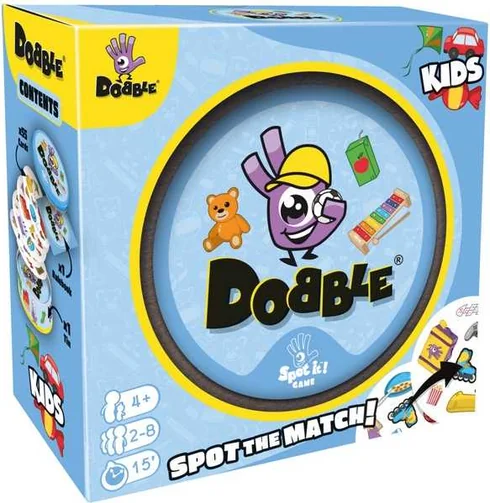
Dobble Kids consists of 30 round cards, each showing six animals in different sizes and positions. Any two cards always have exactly one animal in common. Everyone plays at the same time and tries to be the first to spot the shared animal and name it aloud. The rulebook contains five mini-games. In one, a card lies face up in the middle and the rest are dealt out: whoever names the animal their card shares with the middle card places it on top. Whoever gets rid of all their cards first wins.
What it can help develop
The focus is on visual search: the eyes move across six animals, compare them with the second card and have to ignore size and rotation. Because everyone searches at the same time, processing speed also counts; when the middle card changes, the search starts again. Word retrieval comes in too: the animal has to be named immediately. If a child does not know it, what they lack is the word, not the eye for it.
Especially suitable for
- Children from age 4 who like naming animals
- Short play breaks at home or on the go
- A first speed game before classic Dobble
Less suitable for
- Children who get frustrated quickly under time pressure
- Older school-age children: the original Dobble challenges them more
Our verdict
Dobble Kids is a worthwhile choice for families with children from age 4 who are looking for a first speed game. The rules can be explained in seconds, the box is easy to take along, and there is plenty of laughter. Its limitation lies in the level of challenge, because it remains a brisk observation game, and a few buyers find some animals hard to recognise.
Getting started
- Start with one of the mini-games from the rulebook; two of them are designed especially for children.
- If older children find the search too easy, the original Dobble (from age 6) is the next step.
In detail
Variants and player count
According to jeuxdenim.be, the animal edition of Dobble Kids was published by Asmodee in 2012. Asmodee UK lists 30 cards with animals for 2 to 5 people from age 4, with a playing time of around 10 minutes. According to L’Éclaireur (Fnac), each round card shows six animal pictures, any two cards have exactly one animal in common, and everyone plays at the same time. There are five mini-games; according to Asmodee UK, two of them are designed especially for children, and according to Esprit Jeu, the other three come from Dobble itself. In the base game of Dobble, according to Wikipedia, players name the shared symbol and discard the card; whoever gets rid of all their cards first wins. According to Wikipedia, the variant with 30 cards of six symbols each is called Dobble Kids. According to the publisher’s website, the current edition from Zygomatic Games under the name Dobble Kids has 55 cards with familiar everyday objects and so differs from the animal edition.
What reviewers say
The website jeuxdenim.be says the rules can be explained in seconds and the game is easy to carry and entertaining; according to the website, it does not aim to be more than a quick game. On the Esprit Jeu website, one customer review criticises the fact that some animals, such as the axolotl, are hard to recognise. The sources evaluated name no prizes or awards for this edition.
How it compares
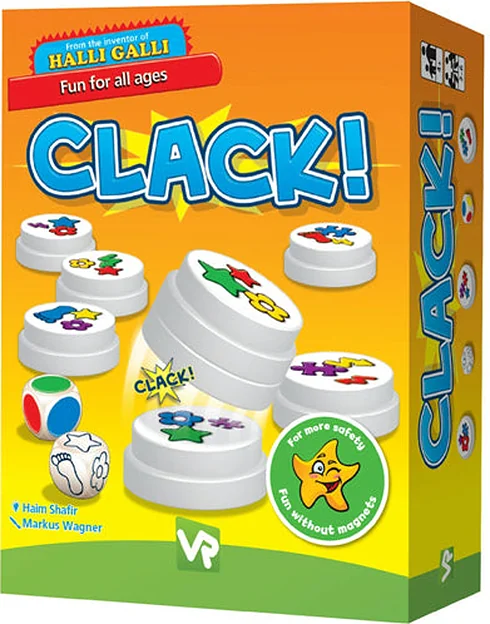
Lucky Sock Dip (from age 4, 2 to 6 people, about 10 minutes) shares the age, the playing time and the skill area of perception and speed with Dobble Kids. Like Dobble Kids, Lucky Sock Dip calls for visual search and processing speed, with impulse control added. Clack! (from age 4, 2 to 6 people, about 10 minutes) and Dobble Kids share the age, the playing time and the skill area of perception and speed. Perception and speed is the only skill area listed for each of the two games. The animal edition of Dobble Kids suits children from age 4 who like naming animals, and short play breaks. It is less suited to children who get frustrated quickly under time pressure and to older school-age children, whom the original Dobble challenges more.
Sources
Frequently asked questions
What age is Dobble Kids suitable for?
Dobble Kids is recommended from age 4. A good sign: the child enjoys naming animals and knows most of them, because a child who does not know an animal fails at the word, not at seeing it. It is less suitable for children who quickly get frustrated under time pressure and for older school-age children.
How long does a game take and how many people can play?
A game takes about 10 minutes, and the game is for 2 to 5 people. Everyone searches at the same time and competes against the others: the rulebook contains five mini-games, and in one of them, whoever gets rid of their cards first wins.
What skills can Dobble Kids help develop?
The focus is on perception and speed: the eyes compare two cards and ignore the size and rotation of the animals while everyone searches at the same time. Quick naming comes in too, because the animal that has been found is named aloud immediately.
Is there more than one way to play?
Yes, the rulebook contains five mini-games, two of them designed especially for children. In one variant, a card lies face up in the middle, and whoever names the shared animal places their card on top of it.