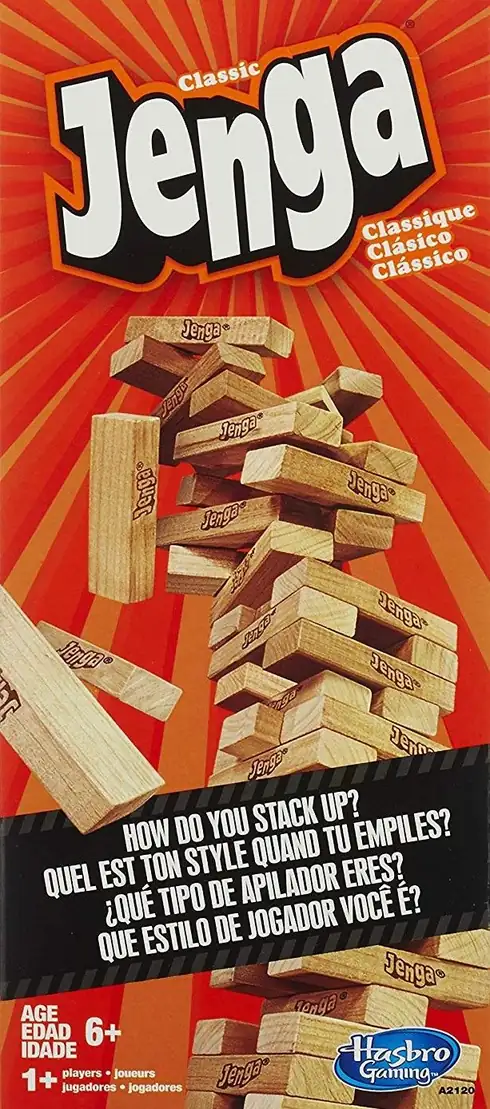
How it plays
Players build a tower from 54 hardwood blocks, using the stacking aid if needed: 18 levels of three blocks each, each layer at right angles to the one below. On their turn, a player uses only one hand to pull out a block from below the highest complete level and places it crosswise on top. If the tower then stays standing for about ten seconds, it is the next person’s turn. Whoever makes it collapse is out; the winner is the last person to have stacked successfully. When playing alone, the aim is to beat your own height record.
What it can help develop
Players may feel the blocks before pulling: by touching them carefully, the child senses which block is loose and which is bearing weight. This takes the sense of touch plus a first feel for how the structure holds. When pushing a block out and placing it on top, a steady hand and finely controlled force count; one jerk and the tower sways. Impulse control comes in too: letting go of a block that is stuck and looking for another instead of impatiently carrying on pulling. The higher the tower, the greater the tension.
Especially suitable for
- Children from age 6 who like stacking and trying things out
- Family groups with children, parents and grandparents
- Impromptu games: the rules are quick to explain
Less suitable for
- Noise-sensitive children: the collapse is loud
- Anyone looking for tactics and variety
Our verdict
Jenga is a worthwhile choice for family groups with children from age 6, parents and grandparents: the rules are understood in minutes, and the tension grows with every turn. In 2020 it was inducted into the American National Toy Hall of Fame. It calls for a steady hand and a delicate touch. Its limitations are the loud collapse for noise-sensitive children and the small role of tactics; some find setting up the tower too time-consuming.
Getting started
- Allow players to feel the blocks first. Children can touch the blocks carefully to find a loose one before pushing it out.
- Explain the rules beforehand: one hand only, one block from below the highest complete level, placed crosswise on top, then wait about ten seconds.
- Build the tower with the stacking aid: 18 levels of three blocks each, each layer at right angles to the one below.
In detail
Variants and player count
According to Hasbro (instructions page for Jenga Classic, A2120), the game is intended for 1 or more players from age 6 and contains 54 hardwood blocks and a stacking aid. According to the Hasbro rules, each level has three blocks, and the levels are laid at right angles to each other; BoardGameGeek names 18 levels. According to the rules, a player uses only one hand to pull out a block from below the highest complete level; before doing so, players may touch blocks to find loose ones. The block is placed on top at right angles, and the player waits about 10 seconds. According to the rules, the winner is the last person to place a block on top without the tower collapsing; when playing alone, the aim is to stack the tower as high as possible. BoardGameGeek also gives the year 1983, the designer Leslie Scott and 1 to 8 players.
What reviewers say
No independent professional review of Jenga is on record. The National Toy Hall of Fame (The Strong) inducted Jenga in 2020. According to its profile, the rules are simple and easy to understand, and success requires balance, patience and dexterity. Individual user comments on BoardGameGeek praise the way minimal rules build real suspense. Other individual comments name the effort of setting up and clearing away, relative to the playing time, as a weakness.
How it compares
Mikado (from age 4, 1 to 6 people, about 15 minutes) shares the skill area of fine motor skills with Jenga and adds impulse control. In Mikado, instead of a tower, there is a jumbled heap of sticks from which players pull out one stick after another. Chairs (from age 6, 1 to 3 people, about 5 minutes) shares the age and the skill area of fine motor skills with Jenga; the profile of Chairs also includes logic and planning. Jenga suits children from age 6 who like stacking and trying things out, and family groups; it is less suited to noise-sensitive children, because the collapse is loud, and to groups looking for tactics and variety.
Sources
Frequently asked questions
What age is Jenga suitable for?
Jenga is recommended from age 6. A child is ready when they enjoy stacking, can pull steadily and carefully with one hand and accept that the tower will collapse loudly at some point. Noise-sensitive children are easily startled by this.
How long does a game take and how many people can play?
A game takes about 15 to 20 minutes. The game is for 1 or more people: whoever makes the tower collapse is out, and whoever last stacked successfully wins. When playing alone, the aim is to beat your own height record.
What skills can Jenga help develop?
The focus is on fine motor skills. When pulling blocks out and placing them on top, what matters is a steady hand and finely controlled force, because even one jerk makes the tower wobble. On top of that comes the sense of touch when testing the blocks, and impulse control when letting go of a block that is stuck.
Is Jenga noisy?
The collapse is loud and can startle noise-sensitive children. Until then, balance, patience and dexterity are what matter most.