How it plays
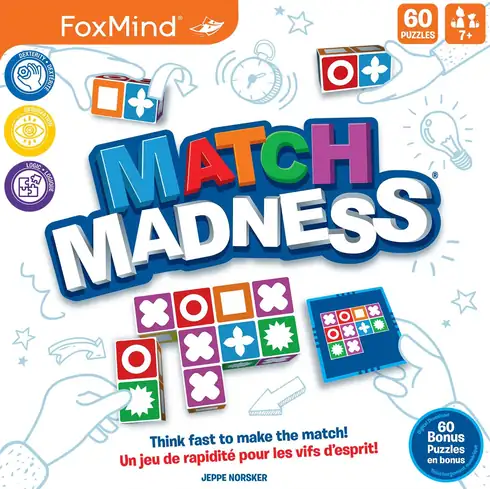
Everyone receives five elongated blocks (like two cubes stuck together); each of the four long sides shows a pair of symbols. A challenge card is turned over, and everyone recreates the pattern at the same time by rotating, flipping and sliding their blocks. Whoever gets it right first wins the card; anyone who has made a mistake is out for that card. In the German edition reviewed, the 60 cards come in five levels; after the agreed number of rounds, whoever has the most cards wins.
What it can help develop
The card only shows the finished picture, not where one block ends. Children break the pattern down into pairs and look for the matching blocks: pattern recognition and visual search. Because the blocks are rotated and flipped, spatial visualisation is required. Players have to keep in mind what is already in place (working memory) and rethink when the last block does not fit (cognitive flexibility). A mistake costs the card: speed and accuracy have to be weighed against each other.
Especially suitable for
- Children from age 7 who enjoy brain-teasers and speed
- Short games for a spare moment, including solo
- Families who adjust the levels to suit different ages
Less suitable for
- Children who cope badly with losing a race
- Quiet evenings: the blocks clatter
Our verdict
Match Madness is a worthwhile choice for children from age 7 who like to puzzle things out and want to be quick, for short games in a spare moment and also for playing solo. Its strength: rules that are quick to explain and excitement in the simultaneous race; in 2022, Match Madness received a US parenting award. Its limitations are the plastic blocks with stick-on symbols of the German edition reviewed, their clattering and an advantage for players with good spatial skills.
Getting started
- Explain that the card only shows the end result: players have to work out for themselves where one block ends.
- If the pattern does not work out, break it down into two-square blocks in a different way; there are often several possibilities.
- Agree on the number of rounds before starting.
In detail
Variants and player count
According to Luding, the German edition, “Crazy Cubes”, is by Jeppe Norsker (HCM Kinzel, Essen 2020) and is intended for 1 to 4 people from age 7, with a playing time of about 20 minutes. According to mit80.de, Norsker published the idea in 2016 as Match Madness; according to FoxMind, Match Madness was published by FoxMind in 2016. According to mit80.de, the four long sides of the blocks show pairs of symbols, and all the blocks have to be used; according to Brettspielblog.ch, anyone who makes a mistake is out for that round. Hall9000 says that the level and the number of cards played can be chosen freely; Hall9000 and Reich der Spiele mention a solo version. Brettspielblog.ch mentions the “Total Crazy” variant.
What reviewers say
spieletest.at finds that the components of the German edition look cheap; Hall9000 describes plastic blocks with stickers. Brettspielblog.ch mentions that players have to imagine the dividing lines of the blocks; according to Brettspielblog.ch, it is a family game that can be used at school. Reich der Spiele finds the principle quick to grasp, calls the stress level high and mentions rattling plastic blocks. Hall9000 sees the “Total Crazy” variant as more suited to experienced players; mit80.de thinks that in the base game the players with strong spatial skills usually win, while “Total Crazy” gives weaker players more of a chance. Writing about the FoxMind edition, Match Madness, The Board Game Family says that faster pattern solvers dominate the race.
How it compares
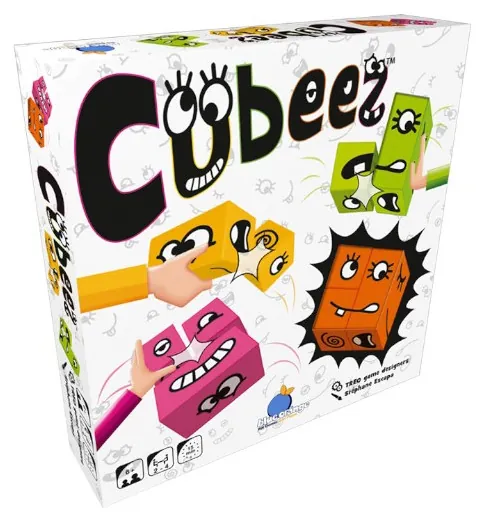
Dr. Eureka (from age 6, 2 to 4 people, about 15 minutes) has the skill areas of fine motor skills as well as logic and planning, like Match Madness; Match Madness also brings in perception and speed. Cubeez (from age 6, 2 to 4 people, about 15 minutes) has the same three skill areas as Match Madness: fine motor skills, logic and planning as well as perception and speed. Cubeez is for 2 to 4 people, while Match Madness can also be played alone. Match Madness suits children from age 7 who enjoy puzzling things out and like speed, also on their own; it is less suited to children who cope badly with losing a race.
Sources
Frequently asked questions
What age is Match Madness suitable for?
Match Madness is recommended from age 7. A child is ready when they can break a pattern down into pairs, rotate blocks in their head and cope with a mistake costing them the card. Children who find losing a race hard are less well served.
How long does a game take and how many people can play?
A game takes about 20 minutes. The game is for 1 to 4 people: everyone recreates the card pattern at the same time, and whoever has the most cards wins. For playing alone there is a solo version; the number of rounds is agreed beforehand.
What skills can Match Madness help develop?
It can help develop fine motor skills, logic and planning as well as perception and speed. The card only shows the end result, so children break it down into pairs, rotate the blocks mentally and keep in mind what is already in place. Children have to keep a balance between speed and accuracy.
Do the fastest players always win?
In the base game, the players with the best spatial skills often win. In the “Total Crazy” variant, each person chooses their own cards and points are scored according to difficulty, which gives weaker players more of a chance.