How it plays
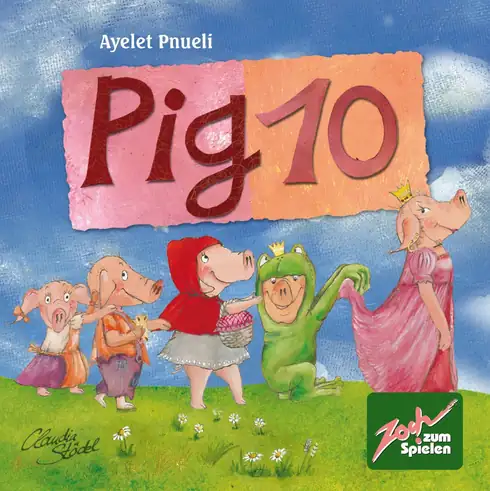
The 80 cards show little pigs in fairy-tale costumes, with values from 0 to 10. Taking turns, players lay one of their three cards in hand in the middle, announce the new total aloud and draw a replacement. Whoever reaches exactly 10 calls out “Pig 10” and wins all the cards on the table; whoever goes over hands them to the previous player. The zero resets the total, and the five may also be subtracted. The winner is whoever collects the most cards.
What it can help develop
Every turn is a mental arithmetic problem: the total stands at 7, so do I have the 3 that makes it up to ten? The special rules call for cognitive flexibility. The zero resets the total, the five may be subtracted, and whoever plays the number of the last card laid or of the total may make that number the new total. Weighing risks comes in too: anyone who brings the total to 9 is taking a chance. The next player hits ten only with the 1, but goes over with many other cards.
Especially suitable for
- Children from age 6 who are practising adding up to 10
- Family groups of two to eight people
- Short games for a spare moment
Less suitable for
- Strategy fans: the luck of the draw decides a lot
- Confident calculators: it soon becomes too easy
Our verdict
Pig 10 is a worthwhile choice for families with children from age six who need to practise adding up to ten, and for groups of up to eight people. Its strength: games are short, and the arithmetic happens along the way. Its limitations are the high luck factor, because choosing between only three cards leaves little scope, and confident calculators, who will soon find it too easy.
Getting started
- Before the first game, play through the example moves from the rules together, introducing the zero, which resets everything, and the five, which may also be subtracted.
- Add the special rule on matching numbers only in a later game, once everyone has mastered the basic rules. According to one review, this is precisely where the most interesting part of the game lies.
In detail
Variants and player count
According to Zoch, the game has 80 cards and is intended for 2 to 8 people from age 6. According to the Zoch rules, players take turns playing one of their three cards in hand, announce the new total of the pile aloud and draw a card. Whoever reaches exactly 10 calls out “Pig 10” and wins all the cards on the table. If the total goes over 10, the person who played before receives the cards. The 5 may be added or subtracted; the 0 resets the total to zero. Whoever has the most cards at the end wins.
What reviewers say
Reich der Spiele (Heike and Andreas Bolle, 2011) considers the sums so simple that young school-age children manage them effortlessly; according to the review, the little pigs dressed as fairy-tale characters appeal to school-age children. As criticism, Reich der Spiele says that it is essentially a game of luck and that with only three cards in hand the decisions are very limited. Escale à jeux (François Haffner, 2011) sees a fairly sophisticated game behind the look of a simple addition game and considers the rule “Même carte, même nombre” (same card, same number) the most interesting part. Jedisjeux describes it in 2012 as a small family game, quite dependent on chance and without strategic depth; according to the review, children enjoy counting and calculating while playing. According to the prize’s website, the Japanese edition received the U-more Award of the Japan Boardgame Prize 2011; the award honours good games for beginners and families.
How it compares
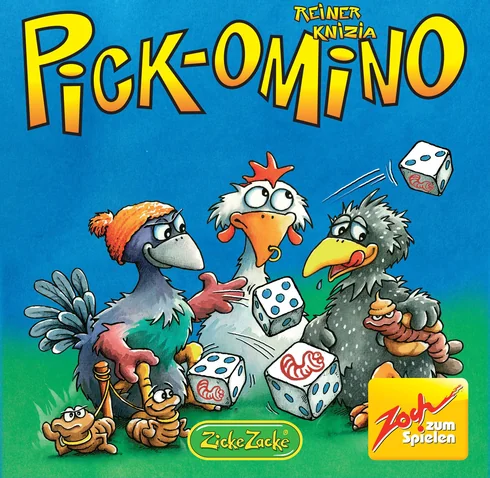
Pickomino (from age 8, 2 to 7 people, 20 to 30 minutes), like Pig 10, covers numbers and arithmetic and also has logic and planning as well as impulse control. Avocado Smash (from age 6, 2 or more people, about 10 minutes) also covers numbers and arithmetic, plus impulse control as well as perception and speed. Pig 10 (from age 6, 2 to 8 people, about 15 minutes) has the same minimum age as Avocado Smash and is the only one of the three games with just this one skill area.
Sources
Frequently asked questions
What age is Pig 10 suitable for?
Pig 10 is recommended from age 6. The sums are so simple that even young school-age children can manage them. A child is ready as soon as they can add numbers up to 10 and announce the total aloud.
How long does a game take and how many people can play?
A game takes about 15 minutes, and the game is for 2 to 8 people, who play against each other. Whoever reaches exactly 10 wins the cards on the table. At the end, whoever has collected the most cards wins.
What skills can Pig 10 help develop?
With Pig 10, children practise numbers and arithmetic. Every turn is a small mental arithmetic problem: if the total is 7, the 3 makes it exactly ten. If the total is 9, the next person can only reach exactly ten with the 1.
Does chance play a big role?
Yes, several reviews call it dependent on chance and lacking strategic depth, as decisions are limited to three cards in hand. Even so, one review considers it cleverer than it first appears.