How it plays
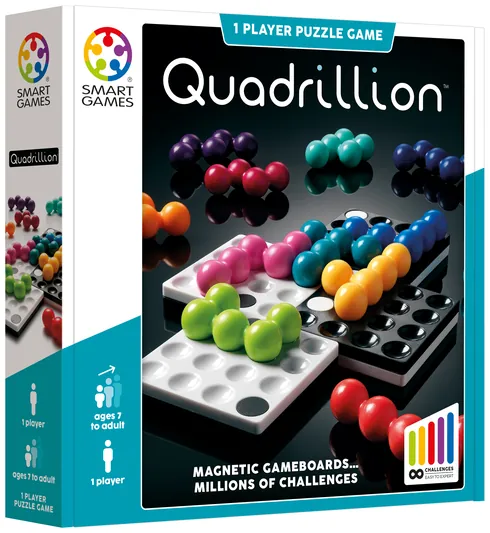
Four double-sided magnetic grids, each with 4 × 4 hollows, click together; black and white dots block spaces. The twelve pieces made of coloured balls have to fill every free space, even across the borders between grids. In the edition reviewed, the booklet offers 80 challenges ranging from easy to very hard: the board shape and some of the pieces are given, and the solution is at the back. In free play, eleven board shapes are allowed, and according to the designer they can always be solved.
What it can help develop
The core is spatial reasoning: the child compares the shape of the gap with the remaining pieces and imagines how one of them would fit in when rotated, before trying it. Mental rotation is central. Problem-solving that looks ahead comes in too: every piece has to leave gaps into which the rest can still fit. If an approach leads to a dead end, it means starting again, which calls for patience and perseverance.
Especially suitable for
- Children from age 7 who enjoy puzzling things out alone
- Children who find small pieces too fiddly
- Parents and grandparents who enjoy brain-teasers too
Less suitable for
- Children who only enjoy playing in company
- Children who give up quickly after failed attempts
Our verdict
Quadrillion is a worthwhile choice for children from age seven who enjoy puzzling things out on their own, and for parents or grandparents who enjoy brain-teasers themselves. Its strength: large, sturdy pieces and a booklet of challenges from easy to very hard. Its limitations are the purely solo format and children who give up quickly after failed attempts.
Getting started
- Show beforehand that pieces may extend across the borders between grids, but not onto the black and white dots.
- Have newcomers start with the easiest challenges in the booklet; it ranges from the “Starter” level to “Wizard”.
- Leave free boards until later: according to the designer, eleven board shapes can always be solved, but for others there is no guarantee that a solution exists.
In detail
Variants and player count
The game includes four double-sided magnetic grids and twelve colourful pieces made of balls in a row, plus a booklet with challenges and solutions. Each grid has 4 × 4 hollows, and the grids click together; black and white dots block spaces, in a different position on each side. The game is intended for 1 person from age 7; the 2016 edition offers more challenges than the earlier one. In classic mode, the booklet specifies the board shape and some of the pieces and gives exactly one solution for each challenge; in free mode, there are no starting requirements. In free play, eleven board shapes are allowed, all of which can be solved according to the designer; for other shapes, there is no guarantee that they can be solved.
What reviewers say
In 2014, Quadrillion received an award at the Belgian Toys & Games of the Year competition in the Think & Logical Games category, and in the same year it won NAPPA silver. The NAPPA jury praises the sturdy pieces and the unlimited challenges and solutions, and calls it suitable for players of all skill levels. In 2017, the “spiel gut” association gave it its award in the category for thinking and patience games, which call for patience and perseverance. The Ludovox presentation from 2014 describes the reversible magnetic grids and distinguishes the classic mode with the booklet from the free mode.
How it compares
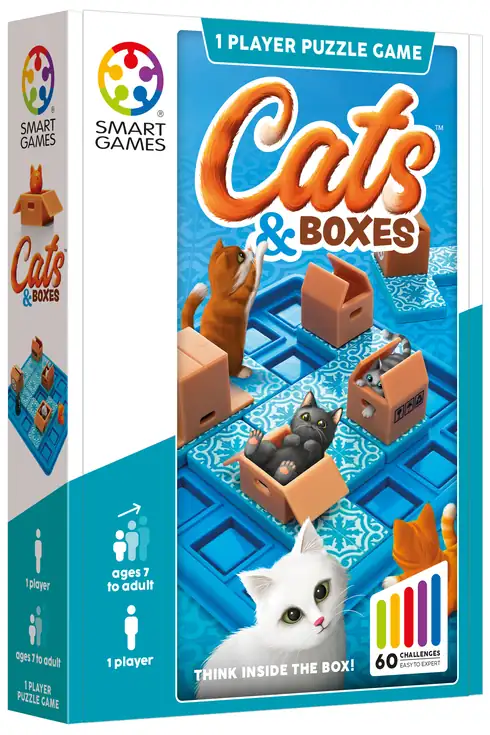
Jump In’ (from age 7, 1 person, flexible playing time) shares spatial reasoning with Quadrillion, but relies on planning sequences of jumps ahead and on cognitive flexibility rather than on fitting pieces together. Cats & Boxes (from age 7, 1 person, flexible playing time) shares spatial reasoning as well as patience and perseverance and is a planning puzzle in a compact format, in a box with a lid. Quadrillion also has large, sturdy pieces and a booklet of challenges, which helps children who find small pieces too fiddly. All three are solo games for children from age 7 who enjoy puzzling things out alone, and less suited to children who prefer playing together. Quadrillion and Cats & Boxes are also less suited to children who give up quickly after failed attempts or dead ends.
Sources
- Smart Games & Puzzles: Quadrillion (designer’s page)
- SmartGames: Quadrillion (publisher’s page)
- SmartGames: Quadrillion (box image)
- SmartGames: Quadrillion (spare part image, grid)
- Ludovox: presentation of Quadrillion (in French)
- SmartGames: awards
- Toys & Games of the Year: 2014 winners
- NAPPA Awards: Quadrillion
- spiel gut: Quadrillion (in German)
Frequently asked questions
What age is Quadrillion suitable for?
Quadrillion is recommended from age 7. A child who enjoys puzzling things out alone and starts again after a failed attempt instead of giving up immediately is ready. Adults also find challenges at their level.
How long does a game take and how many people can play?
The playing time is flexible; the challenges range from easy to very hard. Quadrillion is a solo puzzle for 1 person, with a booklet of challenges.
What skills can Quadrillion help develop?
Quadrillion can help develop logic and planning. Anyone who imagines which piece could fit into the gap when rotated is practising spatial reasoning; at the same time, every piece placed has to leave room for the remaining ones.
Are the pieces suitable for children’s hands?
Yes, the twelve pieces are large and sturdy, and the grids hold together magnetically. This helps children who find small pieces difficult to handle.
What if a child gives up quickly after failed attempts?
In the booklet challenges, some pieces are already in place, and the solution is at the back. This makes it possible to look up a single piece without giving everything away.