How it plays
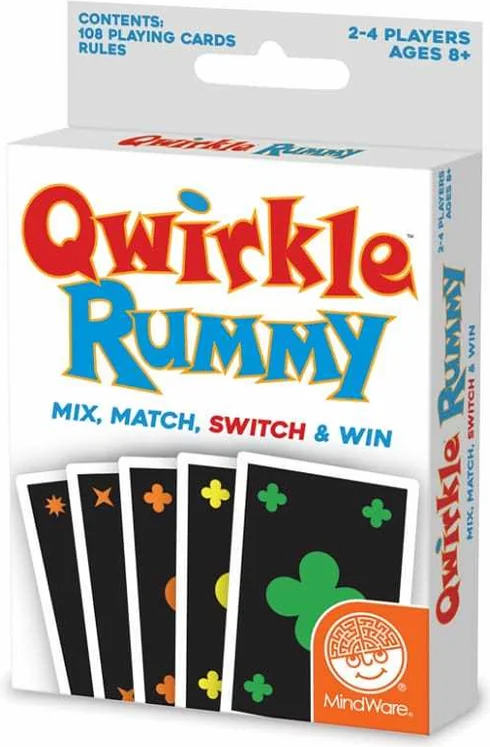
The 108 cards show six symbols in six colours, with each combination appearing three times. Everyone holds nine cards and plays at least one per turn: players start a row of at least three cards and/or add to existing rows. In a row, all the cards have the same colour or the same symbol, and no two are identical. Similar to Rummikub, players may rearrange cards on the table, as long as every row has at least three cards at the end. Whoever brings a row to six cards takes it as a Qwirkle. The player with the most Qwirkles wins.
What it can help develop
Each card can fit into two kinds of row: the green square belongs with the green cards or with the squares. Switching between the sorting rules of colour and shape calls for cognitive flexibility. Rearranging is problem-solving: which card can be taken away without a row dropping below three? The intermediate steps put a load on working memory. Foresight comes in too: anyone who brings a row to five cards may hand the next player a Qwirkle.
Especially suitable for
- School-age children from age 8 who enjoy sorting and puzzling things out
- Qwirkle fans looking for a small travel edition
- Families who like Rummikub
Less suitable for
- Children with colour vision deficiency: in the German edition reviewed, colours are hard to tell apart in poor light
- Children who find it hard to cope when a Qwirkle is snatched away
Our verdict
Qwirkle Rummy is a worthwhile choice for children from age eight who enjoy sorting and puzzling things out, and for Rummikub fans in the family. Its strength: simple rules, a small travel-friendly box and plenty of interplay, because other players can snatch a Qwirkle from under your nose. Its limitations are the lack of depth and, in the German edition reviewed, colours that are hard to tell apart in dim light.
Getting started
- Follow the suggestion in the rules: lay out symbol rows side by side and colour rows below them.
- For newcomers, leave out rearranging as a house rule in the first game and add it later.
- When rearranging, remember which row a card came from so that a failed attempt can be undone.
In detail
Variants and player count
According to Schmidt Spiele (item number 75034), the German edition, “Qwirkle Cards”, by Susan McKinley Ross is intended for 2 to 4 people from age 8. The rules (German, French, Italian) list 108 cards, with each symbol appearing three times in six colours. Everyone holds nine cards and draws back up to nine at the end of their turn. A row consists of at least three cards of the same colour or the same symbol, and no card appears twice. Cards on the table may be regrouped as long as every row has at least three cards at the end. The sixth card in a row makes a Qwirkle; whoever has the most Qwirkles wins.
What reviewers say
According to Wikipedia, the original Qwirkle received the Spiel des Jahres award in 2011; in 2015, the card version “Qwirkle Cards” was published. Reich der Spiele (Johannes Halbig, October 2015) calls the card version a game without great depth and without innovations, but says it is often brought out for a quick game in between. BRDGMZ finds that the game resembles Rummikub, that the rules are simple and quickly understood, and that there is a lot of interaction, because other players can take away the cards a player needs for a Qwirkle. According to BRDGMZ, the small box is good for travelling; in the edition reviewed, the colours are hard to tell apart in the dark, and the game is difficult for colour-blind players.
How it compares
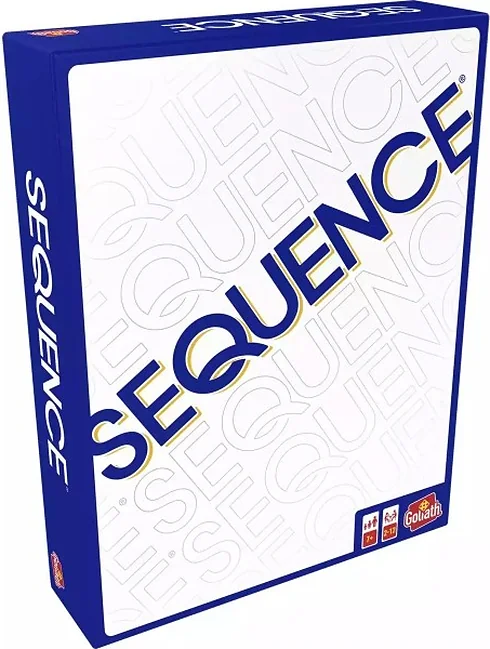
Qwirkle (from age 8, 2 to 4 people, 30 to 45 minutes), like Qwirkle Rummy (from age 8, 2 to 4 people, about 20 minutes), has the skill areas flexibility as well as logic and planning. Qwirkle also has perception and speed. In the original, players add wooden tiles in a line and score points; in Qwirkle Rummy, whoever has the most Qwirkles wins. Sequence (from age 7, 2 to 12 people, about 30 minutes) also has flexibility as well as logic and planning: players form rows of five with tokens on a board. Qwirkle Rummy suits school-age children from age 8 who enjoy sorting and puzzling things out; in the German edition reviewed, it is less suited to children with colour vision deficiency, especially in poor light.
Sources
Frequently asked questions
What age is Qwirkle Rummy suitable for?
Qwirkle Rummy is recommended from age 8. A child is ready when they enjoy sorting, can cope with two sorting rules at once and can handle having a Qwirkle snatched away from them. In the German edition reviewed, colours are hard to tell apart in dim light, which affects children with colour vision deficiency.
How long does a game take and how many people can play?
A game takes about 20 minutes. The game is for 2 to 4 people, who play against each other. Whoever has collected the most Qwirkles wins; a Qwirkle is created when a row grows to six cards.
What skills can Qwirkle Rummy help develop?
Qwirkle Rummy can help develop flexibility as well as logic and planning. The green square can belong with green cards or with squares, so the sorting rule changes. When rearranging, players have to check which card can be removed so that every row keeps at least three cards.
How does Qwirkle Rummy differ from the wooden game?
The principle is related, but the card version comes in a small, travel-friendly box. One review, however, calls it a game without major innovations.