How it plays
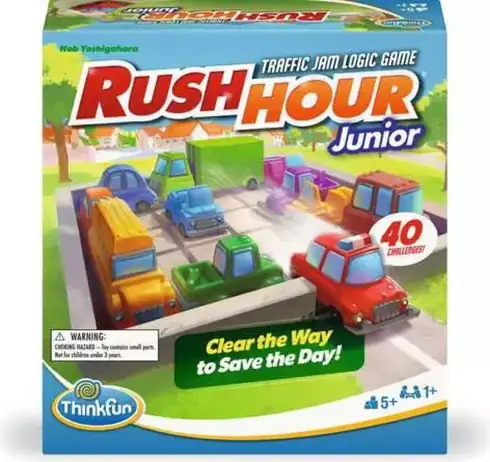
Each challenge card shows where the blocking vehicles are. Stuck in the middle is the ice cream van (in the current edition, a fire engine). All vehicles are only slid back and forth in their lane, never lifted, until the target vehicle reaches the exit. In the edition reviewed, there are 40 cards in four levels, from beginner to expert; the solution is on the back, and the cards are stored in a drawer in the board.
What it can help develop
The game calls above all for planning ahead: the target vehicle only gets free when another vehicle moves out of the way, and that vehicle in turn needs space. Children practise thinking through such chains backwards from the goal. On difficult cards, a vehicle sometimes has to move in what seems to be the wrong direction; the obvious move has to be held back. Spatial reasoning comes in too: how far does a car have to move to clear the lane, and is there room for it? Anyone who reaches a dead end starts afresh.
Especially suitable for
- Children from age 5 who love brain-teasers and enjoy puzzling on their own
- On the go: cards in the drawer, game in the bag
- As a stepping stone to the original Rush Hour
Less suitable for
- Children who only like playing with others
- Experienced puzzlers from age 8: better to go straight for the original
Our verdict
Rush Hour Junior is a worthwhile choice for children from age five who enjoy brain-teasers and like puzzling on their own, and as an introduction to the Rush Hour series. Its strength: the challenges increase in difficulty over four levels, the solution is on the back of the card, and the game is easy to take along. Its limitations are the solo-only format and its limited appeal for experienced puzzlers from age eight, who are better off going for the original.
Getting started
- Before the first move, have the child say which vehicle has to move out of the way first.
- Start with the cards of the easiest level and use the solution on the back only as a last resort.
- For trips, leave the cards in the drawer in the board and take everything along in the bag.
In detail
Variants and player count
The current German-language edition from Ravensburger (item number 76603, ThinkFun) is a game for one person from age 5; the target vehicle is a fire engine. In that edition, the contents include 15 blocking vehicles and challenge cards with solutions in four levels, from beginner to expert. According to the “spiel gut” association, the solution is on the back of each card, and the cards are kept in a drawer in the board. A bag for taking the game along is included. According to “spiel gut”, the earlier edition with the ice cream van also has its cards in four levels. According to Luding, the designer is Nob Yoshigahara, who also invented the original Rush Hour (from age 8).
What reviewers say
For Rush Hour Junior, this site does not evaluate any independent reviews. The “spiel gut” association (founded in 1954) awarded its seal to the ice cream van edition in 2022 and to the fire engine edition in 2024. The association calls the game a challenging pastime that also works on the go and gives a recommended age range of 5 to 10 years. According to Wikipedia, the original Rush Hour is among the 1997 recipients of Mensa Select.
How it compares
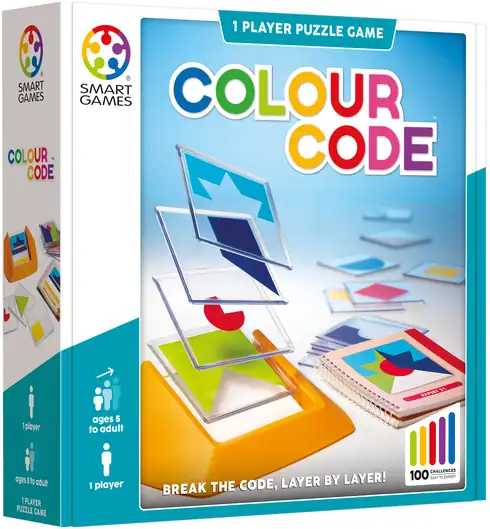
Colour Code (from age 5, 1 person, flexible playing time) and Rush Hour (from age 8, 1 person, flexible playing time) share the skill area of logic and planning with Rush Hour Junior (from age 5, 1 person, flexible playing time). In Colour Code, players recognise shapes in the picture and rotate or flip tiles; in Rush Hour Junior, players slide cars back and forth until the target vehicle is free. Rush Hour Junior works as a stepping stone to the original Rush Hour; experienced puzzlers from age 8 are better off going straight to the original. All three are solo games and are less suited to children who prefer playing with others.
Sources
- Ravensburger: Rush Hour Junior (publisher’s page, Germany, in German)
- Ravensburger: Rush Hour Junior (publisher’s page, Switzerland, in German)
- spiel gut: Rush Hour Junior, 2024 seal (in German)
- spiel gut: Rush Hour Junior, 2022 seal (in German)
- spiel gut: association (in German)
- Luding: Rush Hour Junior (game database, in German)
- Ravensburger: Rush Hour (publisher’s page, in German)
- Luding: Rush Hour (game database, in German)
- Wikipedia: Mensa Select
- Wikipedia (French): Rush hour (casse-tête)
Frequently asked questions
What age is Rush Hour Junior suitable for?
Rush Hour Junior is recommended from age 5, and the “spiel gut” seal gives a recommended age range of 5 to 10. A child who enjoys sliding vehicles back and forth in their lanes and thinking one step ahead while doing so is ready.
How long does a game take and how many people can play?
The playing time is flexible; according to “spiel gut”, it is unlimited. Rush Hour Junior is a puzzle game for 1 child; the cards are kept in a drawer in the board, and a bag makes it easy to take along.
What skills can Rush Hour Junior help develop?
Rush Hour Junior can help develop logic and planning. Often a vehicle is in the way that first has to make room itself. Children resolve such dependencies by working back from the goal and, on difficult cards, realise that the obvious move is not always the right one.
How does Rush Hour Junior differ from the original Rush Hour?
The structure is similar: challenge cards in four levels. However, the original is recommended from age 8; experienced puzzlers of this age are better off going straight for it.