How it plays
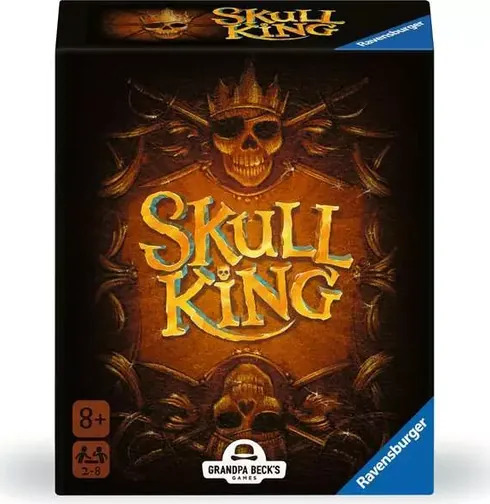
Over ten rounds, the hand grows from one card to ten. After looking at their cards, everyone calls “Yo-ho-ho” and shows with their fingers how many tricks they will take. Players must follow suit, black is the trump suit and special cards may always be played. Pirates beat the suits and the Mermaid, the Skull King beats the pirates, but the Mermaid beats the Skull King; the Escape gives up a trick. An exact bid earns 20 points per trick; otherwise there are 10 penalty points for each trick of difference. The highest score wins.
What it can help develop
Every bid is an estimate under uncertainty: is the black 12 enough for a trick, or will a pirate get in the way? A bid of zero tempts players with lots of points and costs just as many if it fails: pure weighing of risks. Playing cards calls for impulse control: whoever already has their tricks holds back the strong card and deliberately plays an Escape or low cards. If a pirate snatches away a trick that was planned for, players have to replan immediately.
Especially suitable for
- Children from age 8 with some first experience of trick-taking games
- Bold estimators who like to take risks
- Families who know Wizard and are looking for variety
Less suitable for
- Children who find penalty points hard to take
- Players looking for predictable games without a luck factor
Our verdict
Skull King is a worthwhile choice for families whose children from age 8 are getting to know trick-taking games or already know Wizard. Estimating in advance how many tricks a hand will take keeps the tension up until the last round. Its strengths are the pirate theme, the short games and the close scoring. Its limitations are the luck factor, the special cards that are confusing at first and the frustration of penalty points.
Getting started
- Players who know Wizard can carry over the basic bidding mechanism and mainly need to get used to the special cards.
- Before the first round, demonstrate the circle of the three special cards with examples, because according to one review that is exactly where the hurdle lies.
- The first rounds with only one or two cards are a good way to practise bidding with fingers and scoring without pressure.
In detail
Variants and player count
According to Ravensburger, Skull King is intended for 2 to 8 people and takes about 30 to 45 minutes. The reviews cited refer to the 2014 Schmidt edition (item number 75024).
What reviewers say
According to Fairplay, the Schmidt edition came sixth in the À la carte award of Fairplay magazine in 2014, an award that this specialist magazine gives to card games. Reich der Spiele (2015) sees the same mechanism as in Wizard and finds getting started somewhat more complicated because of the many special cards and how they depend on each other. The review also notes that at the start of each round it is unclear which cards are in play. According to brettspielblog.ch (2015), the scoring is balanced: leaders are quickly caught, and the game stays open until the last round. The blog calls the playing time short and the replay value high; according to the blog, the luck of the draw plays a part. The website brettspielbox.de (2014) also sees a similarity to Wizard and finds the triangle of Mermaid, pirate and Skull King appealing. According to brettspielbox.de, the overall ranking stays open into the last rounds; the scoring is somewhat more complex, and with few players the cards are hard to keep track of in the last rounds.
How it compares
Port Royal (from age 8, 2 to 5 people, about 20 to 50 minutes) and Triqueta (from age 7, 2 to 5 people, about 20 to 30 minutes) share both skill areas with Skull King: impulse control as well as logic and planning. In Skull King, the risk is weighed when bidding tricks, in Port Royal when revealing more cards and in Triqueta when deciding whether to take the row or draw another tile. Port Royal is less suited to children who cope badly with wasted turns, and Triqueta to children who cope badly with penalty points and nasty moves. Skull King suits children from age 8 with some first experience of trick-taking games and bold estimators who like to take risks. Anyone looking for predictable games without a luck factor is less well served by Skull King.
Sources
Frequently asked questions
What age is Skull King suitable for?
Skull King is recommended from age 8. A child is usually ready when they already know trick-taking games and can take a round with penalty points without losing interest. Players looking for games with no luck at all are less well served here.
How long does a game take and how many people can play?
A game takes about 30 to 45 minutes. The game is for 2 to 8 people, who play against each other over ten rounds, and the highest score wins at the end.
What skills can Skull King help develop?
Skull King can help develop impulse control as well as logic and planning. Whoever already has their tricks holds back strong cards, and every bid requires judging whether a player’s own hand, for example with a black 12, will really take a trick.
Is Skull King hard to learn?
The sequence of play is easy to follow: bid, play tricks, count. The hurdle is the special cards, because pirate, Skull King and Mermaid beat each other in a circle; the rules include an overview of which card beats which.