How it plays
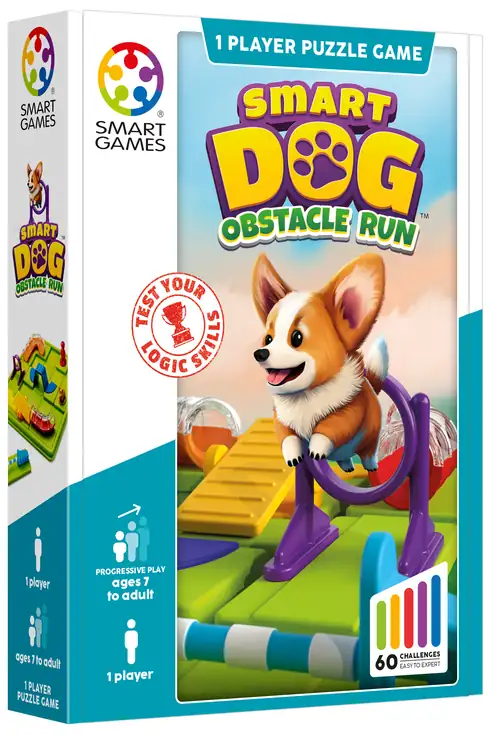
The dog and the trainer are placed on the board where the chosen challenge, one of 60 in the edition reviewed, shows them; easy challenges also fix the positions of some obstacles. The rest of the six obstacles, such as the seesaw, tunnels and bridge, are placed so as to create a continuous path from the dog to the trainer that passes over each obstacle exactly once. The dog runs straight ahead until a bend changes its direction; the pieces do not have to touch. Each challenge has exactly one solution.
What it can help develop
Spatial reasoning is at the centre: where does the path run straight, where does a bend redirect it, and which obstacle goes where? Anyone who starts moving pieces straight away can easily build a path that does not lead to the trainer. The game rewards planning ahead: first running through the route in their head, then placing the pieces. If an attempt ends in a dead end, the child has to rethink: cognitive flexibility on a small scale.
Especially suitable for
- Children from age 7 who enjoy puzzling things out on their own
- Dog lovers, as an introduction to logic puzzles
- On the go: a compact board with a lid
Less suitable for
- Families looking for a game for several players
- Children who give up quickly at dead ends
Our verdict
Smart Dog is a worthwhile choice for children who are already seven and prefer to puzzle things out on their own; dog lovers will find an easy way into logic puzzles here. Its strengths are the sturdy, compact components and the challenges, which get harder step by step. Its limitations are the purely solo format, the limited number of challenges and frustration at dead ends.
Getting started
- Start with the easy challenges, in which some obstacles are already in place.
- Make clear beforehand: the path may lead over empty squares and cross the same square twice, and the hoop and the jump do not change the dog’s direction.
- Help by searching together with the child; the compact box with its lid also suits long car journeys.
In detail
Variants and player count
SmartGames lists the game as Smart Dog (SG 451) in its 2024 range; in German it is called “Pfoten Parcours” and in French “Corgi, chien agile”. The box contains a board with a lid, the dog, the dog trainer, six obstacle pieces and a booklet of challenges with solutions. The obstacles are the seesaw, tunnels, bridge, hoop and jump; only the curved, coloured pieces redirect the dog, while the hoop and the jump do not. Easier challenges show some obstacles in advance; at the most advanced level, only the dog and the trainer are placed.
What reviewers say
MadeForMums gave Smart Dog its Editor’s Choice award in the “Best logic toy/puzzle” category of its Toy Awards 2024; the jury consisted of children and parents. The Art Kit Blog praises the very sturdy, compact components that travel well and the challenges, which range from easy to expert. Go or No Go considers the challenges demanding in terms of time and attention; according to the review, an eight-year-old managed the first ones, and the game is not recommended for children under 7. Gryfgra sees it as a solo game in which solving together is more a matter of parents helping children, and regrets that there are not more challenges.
How it compares
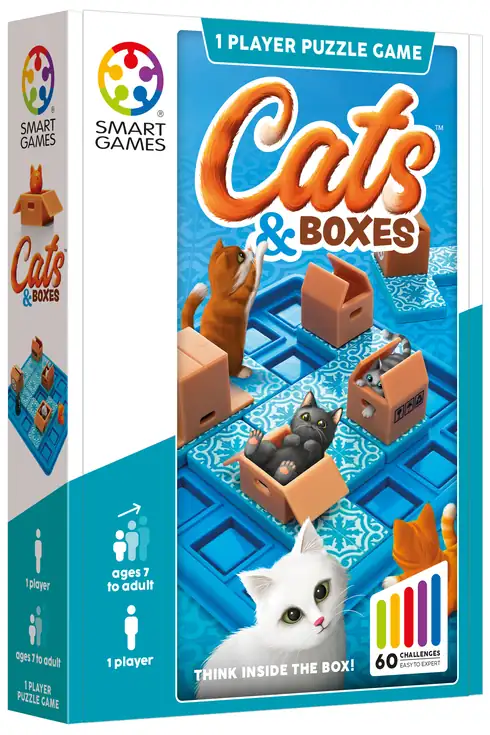
Cats & Boxes (from age 7, 1 person, flexible playing time) has the same age and the same skill area of logic and planning as Smart Dog; both call for planning ahead and spatial reasoning and come in a compact box with a lid. Both are less suited to families looking for a game to play together and to children who give up quickly at dead ends. In Cats & Boxes, players need to check the obvious move, because it is not always the right one; in Smart Dog, it pays to run through the route in your head first. IQ Puzzler Pro (from age 6, 1 person, flexible playing time) also belongs to logic and planning, but calls above all for mental rotation and problem-solving and offers challenges from easy to very tricky. Anyone who needs large pieces that are easy to grip is less well served by IQ Puzzler Pro.
Sources
- SmartGames: Smart Dog (publisher’s page)
- SmartGames & Puzzles: Smart Dog, rules text
- SmartGames: Pfoten Parcours (publisher’s page, in German)
- SmartGames: Corgi, chien agile (publisher’s page, in French)
- SmartGames: publisher archive
- MadeForMums: Toy Awards 2024
- The Art Kit Blog: review
- Roads to Everywhere: review
- Go or No Go: review (in Dutch)
- Gryfgra: review (in Polish)
Frequently asked questions
What age is Smart Dog suitable for?
Smart Dog is recommended from age 7. A child who can follow a path in their head and starts again after a dead end instead of giving up is ready. According to one review, it is not recommended for children under 7.
How long does a game take and how many people can play?
The playing time is flexible, because one challenge is chosen each time. It is played solo (1 person); according to reviews, solving together also happens, for example with help from adults or among children.
What skills can Smart Dog help develop?
Smart Dog can help develop logic and planning, above all spatial reasoning. Children first work out the path in their head and then lay it out; if the first attempt does not lead to the trainer, a new approach is needed.
What can you do if a child gets stuck?
Each challenge has only one solution, which can be looked up in the booklet. Easy challenges fix the positions of some obstacles, and the difficulty rises up to challenges that show only the dog and the trainer.