How it plays
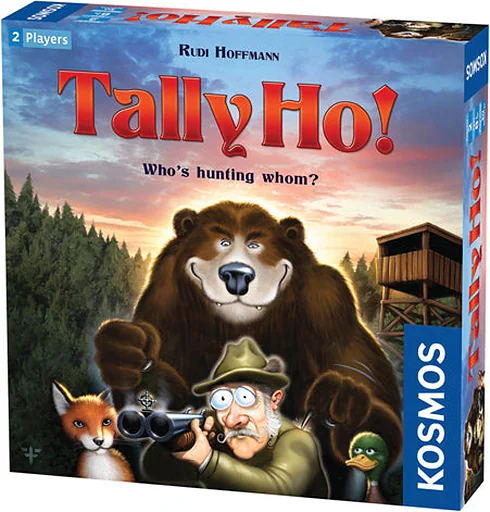
On a board of 7 × 7 squares, 48 cards lie face down. One side controls the hunters and lumberjacks, the other the bears and foxes; ducks and pheasants belong to both, and trees stay where they are. Taking turns, players either turn a card face up or move a piece in a straight line. Capturing earns points: the bear eats people, the fox eats birds, the lumberjack fells trees and the hunter shoots animals, but only in the direction the gun is pointing. At the end, each side has five more moves to take its own pieces off the board through exits at the edge. Whoever has the most points wins, ideally over two games with players switching sides.
What it can help develop
Tally Ho! calls for spatial reasoning: which piece can reach which square, and where is the hunter’s gun aiming? Every time a card is turned over, the risk has to be weighed up: it can open up an opportunity to capture or hand one to the opponent. Anyone who checks a tempting capture first is practising impulse control. The five final moves demand precise planning ahead, and switching sides calls for cognitive flexibility, because different movement rules now apply.
Especially suitable for
- Children from age 8 who still find chess too long
- Parent-and-child duels: luck at the start partly offsets experience
- Children who like to think moves ahead
Less suitable for
- Families who avoid hunting themes
- Puzzlers who are bothered by any element of luck
Our verdict
Tally Ho! is a worthwhile choice for two-player duels, for example between parent and child, when a game of chess would still take too long. The rules are simple, games are short and every card turned over creates new tactical opportunities. Its limitations are the high luck factor, especially at the start, the limited tactical options and the hunting theme, which does not suit every family.
Getting started
- Plan two games straight away and switch sides in between, because the total of both games decides the winner.
- Before each capture, check briefly where the hunter may shoot: the hunter only hits in the direction the gun is pointing.
In detail
Variants and player count
According to Luding and Wikipedia, the game goes back to “Jag und schlag” (Spear, 1973); the Kosmos edition was published in 2000 in the series “Spiele für Zwei”, and the designer is Rudi Hoffmann. According to Wikipedia, the game is played on a 7 × 7 board with 48 cards, with the centre left empty. According to Luding, the 2000 edition contains these 48 cards: 2 bears, 6 foxes, 2 lumberjacks, 8 hunters, 7 ducks, 8 pheasants and 15 trees. According to Wikipedia, the hunter only captures in the direction the gun is pointing. According to Spieletest.at, after the last card is turned over, each side has five final moves in which pieces are moved off the board through four exits. According to Wikipedia, the rules recommend two games with players switching sides; according to Spieletest.at, an extra game with switched roles usually follows, and the overall total decides. According to mit80.de, there were new editions in 2012 and 2015.
What reviewers say
Pöppelkiste describes simple rules; according to the review, luck dominates at the start, the game becomes more strategic later, and early luck helps weaker players. Reich der Spiele sees chess-like moving and capturing with room for tactics despite the luck when cards are turned over. According to the review, the game is easy and short, and several games often follow one after another. The review on mit80.de from 2000 criticises limited tactical options and a fairly high luck factor. Gamesweplay describes the game as deliberately unbalanced, with a short playing time and a considerable luck factor; according to the review, switching roles is easy because games are short.
How it compares
Abalone (from age 7, 2 people, about 30 minutes) has the skill area of logic and planning, like Tally Ho!, but involves no chance. Games are won by thinking ahead, and against opponents of unequal strength the more practised player usually wins. Hive (from age 9, 2 people, about 20 minutes) also involves no chance and calls for spatial reasoning and planning ahead. Tally Ho! (from age 8, 2 people, about 30 minutes), by contrast, has an element of luck when the cards are turned over; this suits parent-and-child duels, because early luck partly offsets experience. Tally Ho! is less suited to puzzlers who are bothered by any element of luck.
Sources
Frequently asked questions
What age is Tally Ho! suitable for?
Tally Ho! is recommended from age 8. A child who likes to think moves ahead and weighs up the risk when turning cards over is ready. Anyone who cannot stand any element of luck or avoids hunting themes is better served by other games.
How long does a game take and how many people can play?
A game takes about 30 minutes. The game is for exactly 2 people, who play against each other. The rules recommend two games with players switching sides; at the end, whoever has the most points overall wins.
What skills can Tally Ho! help develop?
It can help develop logic and planning, above all spatial reasoning: when moving and capturing, players work out in their heads which piece goes where and in which direction the hunter can hit. The last five moves require very precise planning ahead.
How much luck is there in Tally Ho!?
According to one review, luck dominates at the start, and later the game becomes more strategic. Early luck helps weaker players, which makes parent-and-child duels more balanced. Another review considers the luck factor fairly high overall.