How it plays
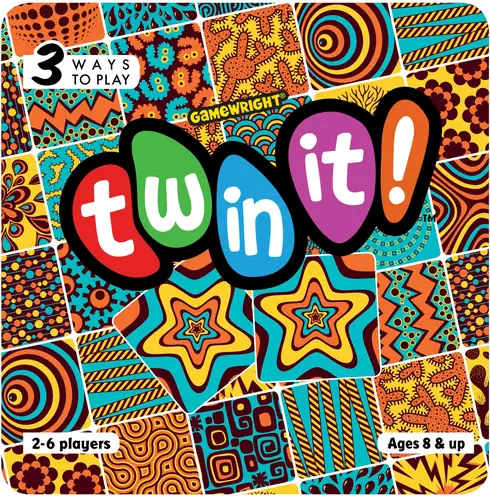
The 135 cards are printed on both sides with abstract patterns: most appear twice, some three times, a few only once. Taking turns, each player turns over the top card of their pile and places it anywhere on the table. Everyone searches at the same time: whoever is first to touch two identical cards, one with each hand, wins them as a set. The top cards of the piles also count; if one is taken, the next one is revealed. With a third matching card, a player can steal a set that has already been won. Whoever has five sets first wins.
What it can help develop
At its core is visual search: the display fills up with every card, and the eyes have to scan the table, the piles and the sets already won again and again. Because colours and shapes are very similar and some cards appear only once as traps, precise visual discrimination counts. Pace is decisive, but whoever touches two cards that do not match loses a set. So impulse control is needed too: look first, then grab.
Especially suitable for
- Children from age 6 who love reaction games
- Mixed-age groups, also playing cooperatively
- Simple rules, up to six at the table
Less suitable for
- Children who quickly get frustrated under time pressure
- Players who would rather think things over calmly than react
Our verdict
Twin it! is a worthwhile choice for families with children from age 6 who like reaction games and look closely. The simple rules and the easily confused patterns go down well in reviews; in Finland it received the award for best party game in 2020. Its limitations are that anyone who quickly loses heart under time pressure or needs time to think will enjoy it less, and that the eyes need breaks in between.
Getting started
- Before the first round, show that the top cards of the piles also count: if one is taken, the next one is revealed.
- Explain to children that a wrong grab only costs a set already won; anyone who has none yet loses nothing.
- Look before you grab: some cards appear only once and look confusingly similar to others.
In detail
Variants and player count
Besides the base game for 2 to 6 people, the rules of the Huch edition describe two further ways to play: a cooperative game and, for 4 to 6 people, a team game. The cooperative variant with one minute of search time also appears in the French rules of the original publisher Cocktail Games from June 2020.
What reviewers say
The review on jungundaltspielt.de describes artwork in a retro style. According to the review, similar colours and patterns provoke wrong grabs, which are penalised, and players have to be very quick. In the reviewer’s judgement, memory plays no part. The Finnish site Lautapeliopas highlights the simple rules and the psychedelic illustrations. In its view, the game needs fewer lightning reflexes than some other speed games. Twin it! was nominated for the As d’Or – Jeu de l’Année 2018; the award went to Azul that year.
How it compares
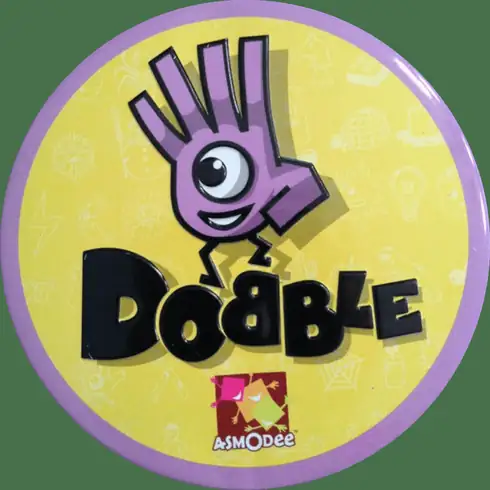
Dobble (from age 6, 2 to 8 people, about 15 minutes), like Twin it!, calls for visual search and speed, plus word retrieval. Dobble is small, quick to explain and good for short games in a spare moment, including with grandparents. Jungle Speed (from age 7, 2 to 10 people, about 15 minutes) shares visual discrimination and reaction speed with Twin it!, plus impulse control. Jungle Speed suits large groups of up to ten people, and is less suited to children who are quickly overwhelmed by hectic play and noise. If younger children play against nimble adults, the pace is unequal. Twin it! remains the choice for mixed-age groups who also want to play cooperatively.
Sources
Frequently asked questions
What age is Twin it! suitable for?
The recommended minimum age is 6. Children who like to react quickly and look closely before they grab are ready. It is less suitable if a child quickly loses heart under time pressure or needs time to think.
How long does a game take and how many people can play?
A game takes about 5 to 10 minutes. The game is for 2 to 6 people, who play against each other, and whoever has collected five sets first wins. For groups there is also a cooperative variant.
What skills can Twin it! help develop?
It can help develop perception and speed. The patterns are easy to confuse and some cards exist only once, so looking closely counts; a wrong grab costs a set that has already been won.
What if adults are much faster?
For this, the rules provide a cooperative variant: within one minute, everyone searches for pairs together and may talk it over, move cards and turn them over. One review recommends it when skill levels differ widely.