How it plays
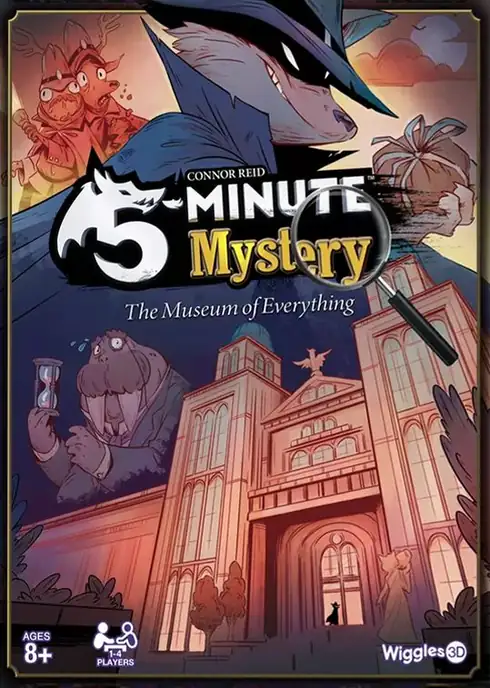
A precious object has disappeared from the museum; there are 28 suspects to choose from, and their cards are dealt out. The team searches scene cards for five hidden symbols; whoever holds the codex sets them, and the back of the card confirms them. In return, the team gets a clue tile in a colour of its choice. If its colour code matches the face-down culprit tile, the thief has the feature shown, such as feathers; if not, the thief does not. Suspects who do not match are discarded. The case file sets the time, often five minutes; arresting the wrong suspect means losing.
What it can help develop
At its core is visual search under time pressure: the symbols are hidden in detailed pictures, some of them almost in the background. This calls for selective attention and careful discrimination between similar symbols. Then comes the sifting: if the culprit has no fur, all suspects with fur are eliminated; which clue colour rules out the most needs careful thought. One player operates the codex while the others search, so children practise coordinating clearly with one another.
Especially suitable for
- Children from age 8 who enjoy seek-and-find pictures
- Families of two to six people
- Mixed-age groups who want to win together
Less suitable for
- Children who quickly freeze under time pressure
- Fans of elaborate detective cases to puzzle over
Our verdict
The game 5-Minute Mystery is suitable for families with children from age 8 who like seek-and-find pictures, solving a museum theft together in a small group. The illustrations and the replay value are praised. Its limitations are that time pressure makes some children freeze, space around a card gets tight with several searchers, and there is no lengthy detective work as in a crime novel.
Getting started
- Take turns with the codex role so that no one person stays in charge.
- Make sure there is good light, because some symbols are hidden almost in the background of the pictures.
- Show how the clue tile works with an example: if its colour code matches the face-down culprit tile, the thief has the feature shown; otherwise not.
In detail
Variants and player count
The designer is Connor Reid, who also created 5-Minute Dungeon. According to Roter Dorn, the Game Factory edition includes 32 scene cards with five symbols each, 28 suspects, 16 colour-coded clue tiles, 16 case files in three levels of difficulty and a codex with five wheels. According to the rules summary on RulesPal (English edition), most cases have five minutes, but not all. A review in the BoardGameGeek forum gives a time limit of 3 to 9 minutes per case.
What reviewers say
According to Game Factory, the game was on the recommendation list of the Österreichischer Spielepreis in 2022, in the “Freunde” category. Roter Dorn praises the illustrations and the replay value, considers good light necessary and larger groups hard to keep track of, and finds the game best with two or three players. According to We Play 2 Learn, it calls for observation and deductive reasoning, and from about three searchers it gets crowded around the cards. As a house rule, We Play 2 Learn suggests sorting the suspect cards in advance by fur, feathers, scales and skin. A review in the BoardGameGeek forum praises the teamwork and the replay value and criticises the way dominant players take over. A player’s account in the BoardGameGeek forum describes the scene cards as small and says that fur, scales and feathers are sometimes hard for children to tell apart.
How it compares
The game 5-Minute Dungeon (from age 8, 2 to 5 people, about 5 to 30 minutes) shares perception and speed as well as cooperation with 5-Minute Mystery; in 5-Minute Dungeon, everyone plays at the same time against a timer. The game 5-Minute Dungeon suits school-age children from age 8 who love speed and hustle and bustle, but is less suited to beginning readers, because the action and event cards have text on them. SET (from age 6, 1 to 8 people, about 20 minutes) shares perception and speed as well as logic and planning with 5-Minute Mystery and adds flexibility; with its solo variant, SET can also be played alone. As with 5-Minute Mystery, children who freeze under time pressure are less well served by both. By contrast, 5-Minute Mystery combines searching with ruling out suspects and suits children from age 8 who enjoy hidden-object pictures.
Sources
Frequently asked questions
What age is 5-Minute Mystery suitable for?
The game 5-Minute Mystery is recommended from age 8. A child is ready when they reliably find symbols in detailed pictures and do not freeze under time pressure. Younger children sometimes find it hard to tell fur, scales and feathers apart.
How long does a game take and how many people can play?
A game takes about 5 to 30 minutes; the case file states which time applies, usually five minutes. The game is for 1 to 6 people, who play together; it works best with two or three.
What skills can 5-Minute Mystery help develop?
The skills profile lists perception and speed, logic and planning as well as cooperation. Because the symbols are hidden in detailed pictures, close observation is needed, and then suspects are ruled out, for example all those with fur if the culprit has none.
Does it also play well in larger groups?
Only to a limited extent. With about three or more people searching, it gets crowded around the scene cards, and loud players quickly dictate how the game goes. In addition, the scene cards are small, so only a few people can see them well.