How it plays
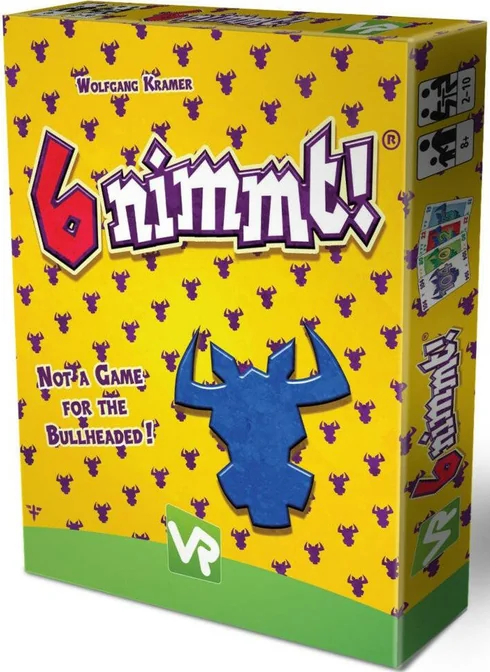
The 104 number cards carry one to seven bullheads, that is, penalty points. Four cards start four rows, and everyone has ten cards in hand. Everyone places a card face down and all the cards are revealed at the same time. Starting with the lowest, each card is added to the row ending in the closest lower number. Whoever lays the sixth card in a row takes the five cards before it. If a card fits nowhere, its player takes a row of their choice. If someone has reached 66 penalty points after a round, whoever has the fewest wins.
What it can help develop
Every card calls for comparing numbers up to 104: does my 47 go after the 38 or the 45? Weighing risks is central: with four cards in a row and a big gap, a player’s own card can easily become the sixth. Perspective-taking comes in too: what will the others play? Because a card that is too low can clear any row, players constantly have to rethink. Sometimes it is wise to resist the urge to dodge and take a cheap row with the lowest card.
Especially suitable for
- Family gatherings and groups of up to ten people
- Children who are confident with numbers up to 100
- Occasional players with no appetite for studying rules
Less suitable for
- Players who want full control: luck plays a part
- Two-player games: it thrives in larger groups
Our verdict
The game 6 nimmt! is a worthwhile choice for larger groups of up to ten people and for children who can compare numbers up to 100 confidently. The rules are quick to explain, and in 1994 it took first place in the Deutscher Spiele Preis. Its limitations are that players who want to plan everything will not be happy with the luck factor, that the theme remains bland and that with two players the game falls short of its potential.
Getting started
- Plan one or two practice rounds: after that, the rules stick.
- Show two rules before you start: whoever completes a row with the sixth card takes the five cards before it, and if a card fits nowhere, its player takes a row of their choice.
- Say beforehand that the game is played over several rounds: it only ends when the first person has 66 penalty points or more.
In detail
Variants and player count
For 2 to 6 people, the rules of the German edition describe a professional variant. It uses only as many cards as the number of players times ten, plus four. All the cards in play are known, and the cards in hand are chosen openly. According to reviews, how much luck plays a part depends on the number of players. Zatu calls 6 nimmt! highly dependent on luck with many people and good with four to six. Brettspielbox observed more luck and chaos with more people, but also more fun than with two. According to the rules, card 55 carries seven bullheads, the highest number.
What reviewers say
Reich der Spiele highlights that players only have to learn four rules for placing cards and that people who rarely play also stand an equal chance. Spieletest.at calls the game quick to explain and especially suitable for large groups. Zatu sees the strategy in anticipating the other players’ moves. According to the English Wikipedia, Stewart Woods (“Eurogames”, 2012) and Mikko Saari (“Lautapeliopas”, 2008) criticise the theme. At the same time, Saari praises the accessibility. According to the publisher, 6 nimmt! was nominated for the Spiel des Jahres 1994; until 1998, the other nominees were placed on the selection list.
How it compares
No Thanks! (from age 8, 3 to 7 people, about 20 minutes), like 6 nimmt!, calls for weighing risks and handling numbers, but only requires confidence with numbers up to 35. No Thanks! is less suited to children who get annoyed when cards are snatched away from them. Ohanami (from age 8, 2 to 4 people, about 20 minutes) has the same age and the same two skill areas as 6 nimmt!, logic and planning as well as numbers and arithmetic. Ohanami is for at most 4 people, while 6 nimmt! can be played by up to 10. For family gatherings with up to ten people and for children who are confident with numbers up to 100, 6 nimmt! is the more likely choice.
Sources
- Amigo: 6 nimmt! rules (PDF, in German)
- Zatu: review
- Brettspielbox: review of the anniversary edition (in German)
- Reich der Spiele: review (in German)
- spieletest.at: review (in German)
- Wikipedia: 6 nimmt!
- Amigo: 6 nimmt! (publisher’s blog, in German)
- Wikipedia (German): Spiel des Jahres
- Wikipedia (Italian): 6 nimmt!
Frequently asked questions
What age is 6 nimmt! suitable for?
The game 6 nimmt! is recommended from age 8. A child is ready when they can compare numbers up to 104 quickly and judge which row a card fits into. Anyone who finds comparing numbers a chore will enjoy it less; on the other hand, there are hardly any rules to study.
How long does a game take and how many people can play?
A game takes about 45 minutes and is played over several rounds. The game is for 2 to 10 people, who play against each other; according to reviews, it is at its best in larger groups.
What skills can 6 nimmt! help develop?
The skills profile lists logic and planning as well as numbers and arithmetic. Children compare numbers and weigh up how risky a row is: if there are four cards in it and the gap is large, their own card can easily become the sixth.
What if only two or three people play?
That works, but with two players the game comes nowhere near its potential. For small groups, one review recommends a reduced set of cards; with four players, only the cards up to 44 are used.