How it plays
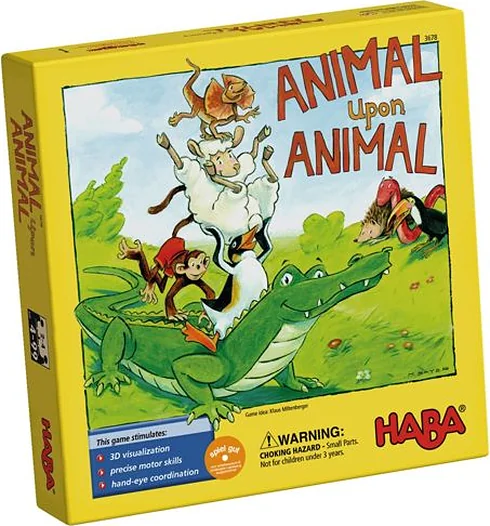
The crocodile stands in the middle of the table and forms the base; each child sets up seven different wooden animals in front of them. Players take turns rolling the die: one or two dots mean placing one or two animals on the pyramid with one hand. There are three further symbols. The crocodile widens the stacking surface, the hand passes one of the player’s own animals to someone else to stack, and with the question mark the others choose the animal. If animals fall off, the player who was stacking takes back up to two. Whoever has none left first wins.
What it can help develop
Because every animal has a different shape, players have to judge where it will rest securely before letting go. They compare contact surfaces, think through the position and rotation of the figure and estimate its centre of gravity: this calls for spatial reasoning. Stacking is done with only one hand; a steady hand, hand-eye coordination and controlled force decide whether the stack holds. When the others choose the animal or a collapse brings figures back, composure is needed too.
Especially suitable for
- Children aged 4 to 6 who enjoy building
- Families with children of different ages
- Children who want to practise finger dexterity through play
Less suitable for
- Children who still find setbacks hard to cope with
- On the go: the stack needs a flat surface
Our verdict
Animal Upon Animal is a worthwhile choice for families with children from age 4 who enjoy building and practising their finger dexterity. High-quality wooden animals and a die that lets children keep up with adults carry the game; in 2005, it made the recommendation list for the Kinderspiel des Jahres. Its limitations are that stacking is more demanding than it looks and that it needs a flat surface.
Getting started
- Before starting, go through the five symbols on the die: one dot, two dots, crocodile, hand and question mark.
- Set the game up on a flat table; on the go, without a firm surface, it makes less sense.
- Agree right at the start that everyone stacks with one hand only, adults included.
In detail
Variants and player count
According to HABA, its current edition (item number 2011189001) contains 29 wooden animals and a symbol die. The crocodile goes in the middle of the table, and each person receives seven different animals. The die shows the symbols one dot, two dots, crocodile, hand and question mark. Stacking is done with one hand; if the stack collapses, the person stacking takes back up to two animals. According to the rules, the game ends as soon as someone has no animals left in front of them. According to Ludovox, the French edition “Pyramide d’animaux” was published by HABA in January 2005, with 29 wooden animals and a symbol die.
What reviewers say
According to the Spiel des Jahres jury, Animal Upon Animal was on the recommendation list for the Kinderspiel des Jahres in 2005; the jury rates the demands as low. The jury describes the back of the crocodile and the animal figures as round, humped, wavy or angled. The blog The Board Game Family writes that children love animals, that the wooden figures are of high quality and that the die gives children a chance against their parents; after one game, the next one starts straight away. No specialist review of Animal Upon Animal is listed.
How it compares
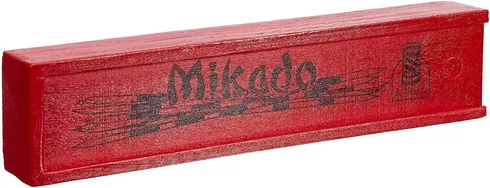
Mikado (from age 4, 1 to 6 people, about 15 minutes) shares with Animal Upon Animal the age, the playing time and the skill area of fine motor skills; both call for a steady hand, and Mikado also has impulse control. Chairs (from age 6, 1 to 3 people, about 5 minutes) has the same skill areas, fine motor skills as well as logic and planning, and, like Animal Upon Animal, calls for spatial reasoning. Animal Upon Animal needs a flat surface, and Chairs a table that stands firmly. Animal Upon Animal suits children aged 4 to 6 who enjoy building and family groups with children of different ages; it is less suited to children who still find setbacks hard to cope with.
Sources
Frequently asked questions
What age is Animal Upon Animal suitable for?
The recommended minimum age is 4. Children aged 4 to 6 who like building carefully and stack with one hand, even when the tower wobbles, are ready. Children for whom a mishap quickly causes frustration find it harder.
How long does a game take and how many people can play?
A game takes about 15 minutes. The game is for 2 to 4 people, who play against each other, and whoever has no animals left in front of them first wins. Thanks to the die, children can hold their own against adults too.
What skills can Animal Upon Animal help develop?
It can help develop fine motor skills as well as logic and planning. Every animal has a different shape, so players have to judge where it will stand firmly before letting go; stacking is done with only one hand, which requires a steady hand.
What happens if the stack collapses?
If animals fall off, the player who was stacking takes back up to two of them, and the game continues. The winner is whoever has no animals left in front of them first.