How it plays
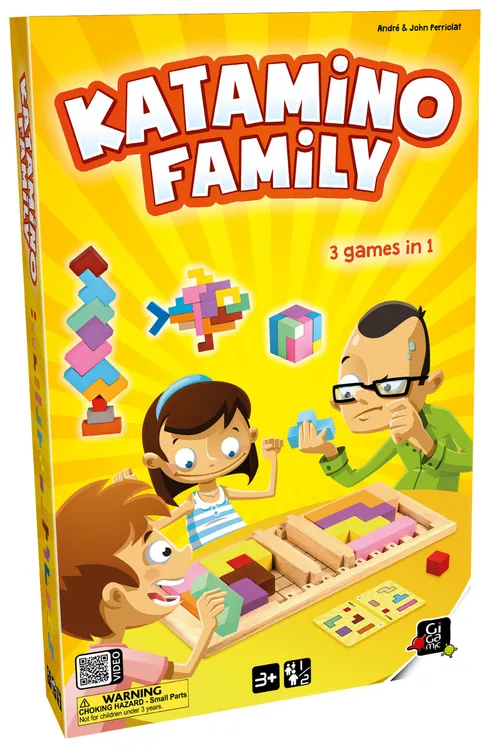
On the wooden board, two players each use a slider to mark off an area, three by five squares to begin with. A card shows which of the 18 wooden pieces to take. At a signal, both fill their area without leaving gaps; whoever finishes first scores a point. Then each player chooses a pentomino (five squares) for their opponent, and the area grows by one row. After three to four duels, the higher score wins. The box also has solo and 3D challenges, and for three-year-olds there are animal shapes to recreate and the balancing game “Kataboom!”
What it can help develop
The focus is on spatial reasoning: does the piece fit if it is turned or flipped over? Players who run through the rotation in their head beforehand need fewer attempts: mental rotation. Because every duel brings one more piece, a finished solution often has to be rebuilt: cognitive flexibility. In the duel, speed comes into play; the youngest children practise looking closely and keeping a steady hand.
Especially suitable for
- Children from age 3 who enjoy laying out and stacking pieces
- Parent-and-child duels between players of different skill levels
- Children who also enjoy puzzling things out on their own
Less suitable for
- Children who give up quickly under time pressure
- Experienced solo puzzlers: the classic version of the game is more demanding
Our verdict
Katamino Family is a worthwhile choice for families with children from age 3 who enjoy laying out and stacking pieces, and for parent-and-child duels between players of different skill levels. The two-colour cards make the race fair, and the game grows with the players. In France, where it is called “Gagne ton papa”, it received the Cocorico du Jouet in 2023. Its limitations are frustration for children who are never ahead in the race and less of a challenge for experienced solo puzzlers.
Getting started
- Start with puzzles for the youngest, such as the animal shapes, and only then move on to the duels.
- Show that the pieces may be turned and flipped over in any way. Players who imagine the rotation first save attempts.
- Simplify the duel for younger children at first, as the author of one personal account did with a five-year-old: without the extra pentomino.
In detail
Variants and player count
According to Gigamic, Katamino Family is aimed at 1 to 2 people aged 3 to 10. The balancing game “Kataboom!”, part of the introduction from age 3, is intended for two or more people. Together with the animal shapes, the rules put the emphasis here on fine motor skills and imagination. For unequal duels, the game includes nine two-colour cards on which the child’s area is one level smaller than the adult’s. According to its rules, the French edition, “Gagne ton papa”, contains the same components and the same chapters, from the puzzles from age 3 to the 3D challenges.
What reviewers say
At the 2023 Cocorico du Jouet, with which specialist toy retail chains honoured nine French toys, “Gagne ton papa” received an award in the “Passion du jeu” category. In 2022, Board’s Eye View called the set versatile and praised the solid wooden pieces and the high replay value. However, the review considered the solo variants less demanding than the classic version of the game. In the same year, What Board Game highlighted the well-made, painted wooden pieces. According to this review, the two-colour cards allow fair duels between players of different skill levels. In 2020, the French review by Paradoxe Temporel described “Gagne ton papa” as a game that grows with the child and also praised the wood.
How it compares
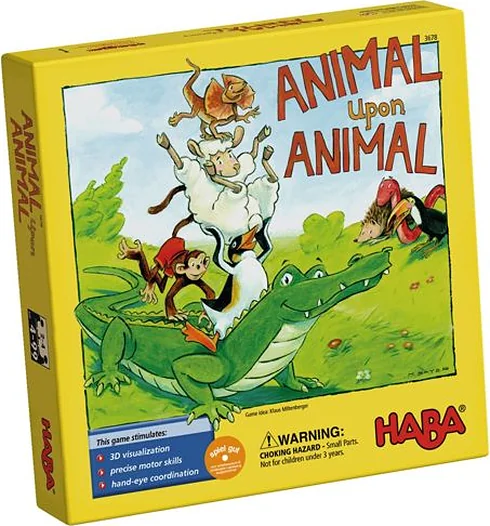
Ubongo (from age 8, 1 to 4 people, about 25 minutes), like Katamino Family, calls for spatial reasoning and mental rotation, plus speed. Ubongo suits children who enjoy puzzling things out, and in mixed groups two difficulty levels even things out. Children who quickly freeze under time pressure will enjoy Ubongo less. Animal Upon Animal (from age 4, 2 to 4 people, about 15 minutes) shares fine motor skills as well as logic and planning with Katamino Family and suits children aged 4 to 6 who like building. Animal Upon Animal also works for mixed-age family groups, less well for children who still find setbacks hard to cope with. For three-year-olds and duels for two, Katamino Family remains the right choice.
Sources
Frequently asked questions
What age is Katamino Family suitable for?
Katamino Family is recommended from age 3. The animal shapes to recreate and the balancing game “Kataboom!” are intended for the youngest children; the duels come later. Children who quickly lose heart under time pressure are better off with ways of playing without a race.
How long does a game take and how many people can play?
A game takes about 15 minutes. The game is for 1 to 2 people: alone with the solo challenges or as a duel for two, in which the higher score wins after three to four rounds.
What skills can Katamino Family help develop?
It can help develop fine motor skills as well as logic and planning, above all spatial reasoning. Checking the rotation of a piece mentally beforehand saves attempts. Because a piece is added with every duel, a finished solution often has to be rebuilt.
How well do duels between a child and a parent work?
The two-colour cards even out differences in skill: the child fills a smaller area than the adult. Even so, a teaching worksheet warns of frustration when children are never the first to finish, and suggests playing to a time limit and counting the shapes completed.