How it plays
The board holds six coloured bases; added to these are six matching marbles, five short and two long ramps and two spacers. In the edition reviewed, each of the 80 challenges in the booklet specifies which marbles are used and in which base every marble should land. Each marble is released above the base of its own colour, and the track has to guide it from there to its destination. If every marble lands correctly in the test run, the challenge is solved.
What it can help develop
DropZone calls above all for spatial reasoning and planning ahead: before attaching a piece, good builders work out in their heads where the marble will roll and whether the next track piece will catch it. If several marbles are in play, a single construction has to get all of them to their destinations, so several requirements stay in working memory at once. If a marble lands in the wrong place, the test run shows where the plan did not work: targeted problem-solving instead of trial and error. Fitting the pieces together also takes a little manual dexterity along the way.
Especially suitable for
- Children from age 8 who like tinkering and building
- Marble run fans who also want to solve puzzles
- Quiet solo time after school
Less suitable for
- Social gatherings: DropZone is a solo game
- Children who give up quickly on tricky challenges
Our verdict
DropZone is a worthwhile choice for children from age 8 who enjoy building things and appreciate quiet time alone with a marble run. One review praises the sturdy tracks, and even some of the easier levels require thought. Its limitations are the lack of social play, as it is purely a solo game, and instructions that are hard to understand at first. Marbles in the middle storage tray are also hard to reach once the track is built.
Getting started
- Treat the first three challenges as a warm-up: according to one review, the instructions and solution arrows are hard to understand at first, but this passes after about three challenges.
- Before building, make clear where each marble starts (above the base of its own colour) and where the challenge says it should land.
In detail
Variants and player count
SmartGames lists DropZone for 1 person from age 8. According to the publisher’s English page, the box contains a board with six bases, six marbles, two spacers, five short and two long ramps and a challenge booklet. According to a press text on kribbelbunt.de, the six bases are red, green, blue, purple, yellow and orange, and the track pieces are made of semi-transparent plastic. The booklet contains the challenges together with their solutions; each challenge specifies which marbles are used and in which base each marble should land, and the target base changes from challenge to challenge. Each marble is released above the base of its own colour; players test the track by releasing the marbles at the starting point. The publisher’s English page includes a warning about small parts.
What reviewers say
The review on Dad’s Life from September 2026 praises solid plastic tracks and well-balanced challenges; according to the review, even the junior levels require head-scratching. According to the review, the instructions and solution arrows were hard to understand at first, but clear after about three challenges. As a criticism, the review mentions that marbles in the storage tray in the middle are hard to reach once the track is standing. This is the only review on record.
How it compares
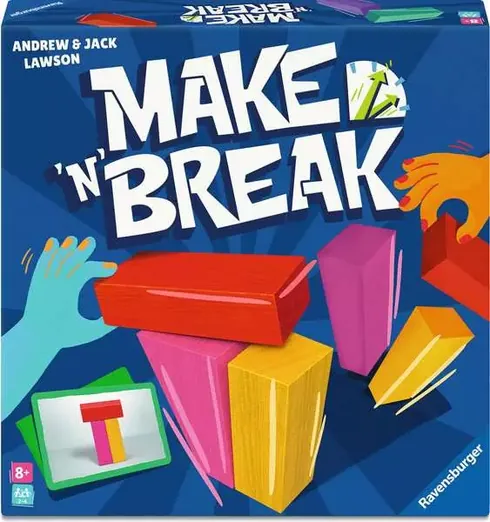
Tangram (from age 8, 1 person, about 10 to 15 minutes) shares the skill areas of fine motor skills as well as logic and planning with DropZone and, like DropZone, calls for spatial reasoning and problem-solving. Instead of track pieces, Tangram has seven shapes to lay. Make ’n’ Break (from age 8, 2 to 4 people, about 30 minutes) has the same skill areas plus perception and speed and, like DropZone, calls for spatial reasoning. In Make ’n’ Break several players build in a race, while in DropZone one player puzzles alone. DropZone suits puzzle-loving children from age 8 who like building, and marble run fans who also want to solve puzzles. It is less suitable for social gatherings and for children who give up quickly on tricky challenges.
Sources
Frequently asked questions
What age is DropZone suitable for?
DropZone is recommended from age 8. A child who likes building and sticks with tricky challenges is ready. Children who give up quickly will find the solution to every challenge in the booklet; because of the small parts, it is not suitable for toddlers.
How long does DropZone take and how many people can play?
DropZone is a game for 1 person and is not suitable for social gatherings. The playing time is flexible, because each challenge can be solved separately, for example as a quiet break after school.
What skills can DropZone help develop?
It can help develop fine motor skills as well as logic and planning. When building, players think in advance about which route each marble will take and whether the track will lead it to the right base. With several marbles, several conditions have to be kept in mind at once. Fitting the pieces together also calls for manual dexterity along the way.
What can you do if a challenge does not work out?
The test run reveals where the construction fails, and the next attempt can address that point directly. If it still does not work, the challenge booklet contains the solutions to all the challenges.