How it plays
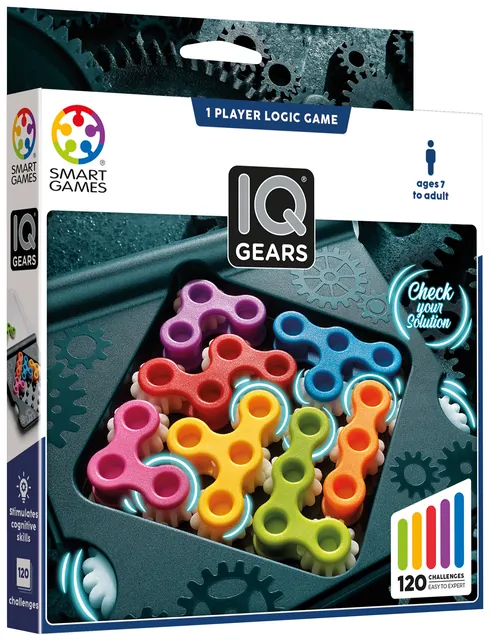
The compact board with a transparent lid has a diamond-shaped playing area with pegs, with a large gear on the left and another on the right. Added to this are seven brightly coloured pieces with small gears and a booklet of challenges up to expert level (120 in the edition reviewed). Each challenge shows which pieces go where; the remaining pieces have to fit in without gaps and form a chain of gears from left to right. Each challenge has exactly one solution, and with it, both large gears turn together.
What it can help develop
IQ Gears calls above all for spatial reasoning, more precisely mental rotation: before a piece goes on the board, players work out in their heads how it fits into a gap once rotated. Then there is the double condition: filling the board while also completing the chain from left to right. Keeping both in view puts a load on working memory. If an approach leads to a dead end, the answer is to take pieces out and plan again. This calls for patient, systematic problem-solving.
Especially suitable for
- School-age children from age 7 who like puzzling things out on their own
- On the go, in the waiting room, on holiday
- Children fascinated by mechanics and gears
Less suitable for
- Children who prefer playing with others
- Children who give up quickly on tricky challenges
Our verdict
IQ Gears is a worthwhile choice for school-age children from age 7 who enjoy puzzling on their own and like gears. The booklet offers challenges up to expert level, and the game checks itself: with the right solution, both large gears turn together. The publisher names several awards from 2024, including the Speelgoed van het Jaar in the Netherlands. Its limitations are that it is purely a solo game and that some children give up on the tricky challenges.
Getting started
- First show the double condition: the board has to be filled without gaps, and the gears have to connect the left side with the right.
- Rotate a piece in your head first and compare it with the gap before placing it on the board.
- At a dead end, feel free to take the pieces out and start again; this is part of the game and a chance to practise a systematic approach.
In detail
Variants and player count
According to the publisher SmartGames, IQ Gears (SG 307) belongs to the Pocket Games category and is a game for one person from age 7. The contents are a compact board with a transparent lid, seven puzzle pieces with gears and a booklet of challenges with solutions. The challenges range from easy to expert, and each challenge has exactly one solution. According to the publisher, all the pieces must fit and form a connection from left to right; the large gears at the sides then turn together. The French publisher’s page calls this connection a chain of gears between the large wheels on the left and right.
What reviewers say
This site does not evaluate independent reviews for IQ Gears; the information comes from publisher and distributor pages. According to the publisher’s list of awards, IQ Gears won the Speelgoed van het Jaar in the Netherlands in 2024 (Puzzles category) and gold at the Independent Toy Awards in Great Britain (educational games category). A British distributor also lists silver at the MadeForMums Toy Awards 2024 (Best Logic Toy/Puzzle). According to its French page, the publisher associates the game with concentration, logic, planning and problem-solving; the Dutch page also names flexible thinking.
How it compares
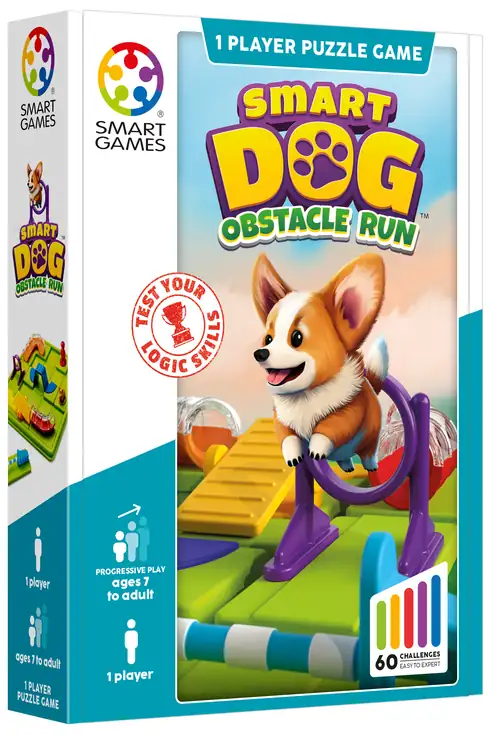
Smart Dog (from age 7, 1 person, flexible playing time) and Jump In’ (from age 7, 1 person, flexible playing time) have the same age and the same skill area, logic and planning, as IQ Gears. In IQ Gears, all the pieces have to fit on the board and form a chain of gears. In Smart Dog, players build a path to the trainer, and in Jump In’, rabbits jump and are at the same time obstacles. All three are solo games with a board and lid that is suitable for taking on the go, and are less suited to playing together in a group. IQ Gears calls above all for spatial reasoning and mental rotation, Jump In’ for planning ahead and cognitive flexibility.
Sources
- SmartGames: IQ Gears (publisher’s page)
- SmartGames: IQ Gears (publisher’s page, in French)
- SmartGames: IQ Gears (publisher’s page, in Dutch)
- SmartGames: awards (publisher’s page)
- SmartGames: “Speelgoed van het Jaar 2024” logo (product page, in Dutch)
- SmartGames: “Independent Toy Awards 2024” logo (product page)
- Smart Toys and Games: IQ Gears (distributor)
Frequently asked questions
What age is IQ Gears suitable for?
The game is recommended from age 7. A child is ready when they like puzzling things out on their own, enjoy rotating pieces in their head and stick with tricky challenges. Children who prefer playing with others or give up quickly will enjoy it less.
How long does a game take and how many people can play?
IQ Gears is a game for 1 person and is played solo. The playing time is flexible. The booklet contains challenges from easy to expert, and each has exactly one solution.
What skills can IQ Gears help develop?
The focus is on logic and planning, especially spatial reasoning. Even before placing a piece, players try out in their heads how it fits into the gap once rotated. Patience is needed when a dead end means planning again.
How does a child know whether the solution is right?
The game checks itself: only with the right solution do the gears connect the left side with the right, so that the large gears turn together. The booklet also contains the solution to every challenge.