How it plays
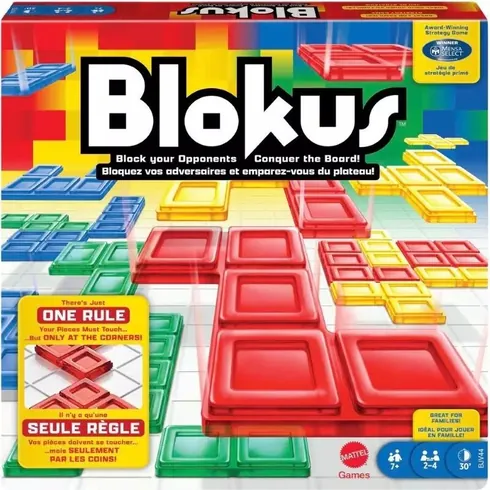
Each colour starts in its own corner of the board, which has 400 spaces. Everyone has the same 21 Tetris-like pieces made up of one to five squares. Players take turns placing a piece: it must touch one of their own pieces by at least one corner, but never along an edge; other colours may be touched freely. Anyone who can no longer place a piece has to sit out. The winner is whoever has the fewest squares left at the end.
What it can help develop
Blokus calls for spatial reasoning and mental rotation: on every turn, players check whether a piece fits into a gap when rotated or flipped. Anyone who cannot picture this yet turns the piece in their hand; this, too, is a way to practise matching shape to gap. On top of this comes planning over several turns: keeping your own corners open as connection points, placing large pieces early and saving small ones for tight gaps. Anyone who spots the others’ open corners can block them; if a player’s own preferred corner is blocked, cognitive flexibility is needed.
Especially suitable for
- Children from age 7 who enjoy brain-teasers
- Mixed family groups: quick to explain
- Groups of four: that is when the board gets crowded
Less suitable for
- Children who take being blocked personally
- Anyone looking for a story in a game
Our verdict
Blokus is a worthwhile choice for children from age 7 who enjoy brain-teasers and for mixed family groups, ideally with four players. The rules can be explained in about a minute, and in 2001 the game received the Super As d’Or. Its limitations are that anyone who takes being blocked personally will get little enjoyment from it, players shut in early have to watch and the game does not tell a story.
Getting started
- Show the placement rule first: new pieces are only placed corner to corner with your own pieces, never edge to edge; other colours may be touched freely.
- As a rule of thumb, use up the large five-square pieces first and save small ones for tight spots later on.
- With two or three players, clarify beforehand: with two, each person plays two colours; with three, everyone shares the fourth colour.
In detail
Variants and player count
According to Mattel, the box contains 84 pieces in four colours, 21 per colour: one single square, one two-square piece, two three-square pieces, five four-square pieces and twelve five-square pieces. For the three-player game, in which everyone shares the fourth colour, opinions are critical: Hall9000 rejects this variant with a neutral colour, Brettarium finds it contrived and Superfred somewhat contrived. By contrast, according to Hall9000, the four-player game is where the fun really lies, and Superfred calls Blokus practically ideal for 4 players.
What reviewers say
The Spiel des Jahres jury, which put Blokus on the selection list in 2002, calls the design as brilliantly simple and clear as the rules. The blog Rezensionen für Millionen notes that Blokus can be explained in a minute. When it comes to rotating and flipping the pieces, the blog sees differences: some players can picture it, others try it out. Hall9000 considers the game suitable for occasional players and avid gamers alike and stresses that it calls for spatial reasoning skills. Superfred observes that it also goes down well with players who do not usually enjoy abstract games. Brettarium notes that players blocked early have to pass and watch, and calls Blokus completely theme-free.
How it compares
Ubongo (from age 8, 1 to 4 people, about 25 minutes) calls for spatial reasoning and mental rotation, like Blokus, and also for processing speed. Two difficulty levels even things out in mixed groups, and Ubongo can be played solo against the clock. Ubongo is less suited to children who quickly freeze under time pressure. NMBR 9 (from age 8, 1 to 4 people, about 20 minutes) combines spatial reasoning and planning ahead with mental arithmetic. In NMBR 9, everyone plays at the same time and it can also be played solo, but it is less suited to groups looking for interaction and direct competition. Blokus suits children from as young as 7 and especially groups of four, in which the board gets crowded.
Sources
Frequently asked questions
What age is Blokus suitable for?
Blokus is recommended from age 7. A child is ready when they can rotate and flip pieces in their head or in their hand until they fit into a gap, and can cope with being hemmed in by others.
How long does a game take and how many people can play?
A game takes 20 to 30 minutes. The game is for 2 to 4 people, who play against each other; reviews like it best with four, and with three, everyone shares a fourth colour, which is considered contrived.
What skills can Blokus help develop?
The skills profile lists logic and planning. On every turn, children check whether a piece fits into a gap after rotating or flipping it, and they plan several turns ahead, for example by keeping their own connecting corners open.
What if a child gets shut in early?
That is part of the game: anyone who can no longer place a piece has to sit out, and anyone blocked early has to watch. Children who quickly feel personally attacked will get little enjoyment from it.