How it plays
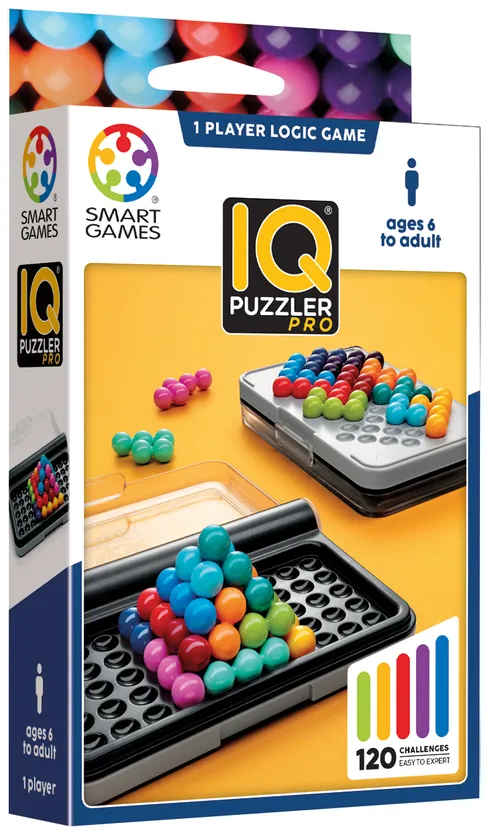
The case with its transparent lid doubles as the board; it comes with twelve pieces made of joined spheres and a booklet of challenges (120 in the edition reviewed). Each challenge shows which pieces are already fixed in place; all the others have to be fitted in without leaving gaps. The game is played flat, as a pyramid or on the diagonal grid on the outside. At first, only a few pieces are missing; at the highest level, only one is given. Each challenge has exactly one solution.
What it can help develop
At its core is mental rotation: anyone who can judge in their head how a piece will fit into a gap when turned or flipped over needs fewer attempts by hand. Added to this is systematic problem-solving: filling tight corners first and recognising early that no piece will fit into a cut-off gap avoids dead ends. Difficult challenges call for hypotheses, taking pieces out again and starting afresh, which requires working memory and perseverance. In the pyramid, the bottom layer determines what still fits on top.
Especially suitable for
- Children from age 6 who enjoy puzzling things out on their own
- On the go: on the train, in the waiting room, on holiday
- Lasts a long time: from easy to very tricky
Less suitable for
- Children who prefer playing in company
- Anyone who needs large pieces that are easy to grip
Our verdict
IQ Puzzler Pro is a worthwhile choice for children from age 6 who enjoy puzzling things out on their own, and as a travel game for young and old. The challenges, from simple to tricky, keep it in use for a long time. According to the publisher, it received the Tillywig Brain Child Award in 2016; the “spiel gut” seal followed in 2020. Its limitations are that it is purely a solo game and its compact format, which one customer review finds a little small.
Getting started
- Try out the three modes of play one after the other: flat, as a pyramid and on the diagonal grid on the outside.
- Make clear at the start that the pieces given may not be moved and that all the others have to be fitted in without leaving gaps.
- Fill tight corners first and check whether a piece can still fit into a cut-off gap at all. This makes dead ends visible early on.
In detail
Variants and player count
The publisher SmartGames offers IQ Puzzler Pro for 1 person from age 6; the compact board with a transparent lid, which serves as a travel case, holds 12 pieces and a booklet of challenges with solutions. According to the publisher, it is played in three modes: flat, as a pyramid or diagonally. Each challenge has exactly one solution, and pieces that are given may not be moved. According to the retailer Esprit Jeu, there are three grids: two on the inside, for 2D and 3D, and one on the outside for diagonal challenges. At the Wizard level, only one starting piece is given, and the remaining eleven have to be placed.
What reviewers say
No independent review of IQ Puzzler Pro is on record. According to the publisher’s list of awards, it received the Tillywig Brain Child Award and the Creative Child Magazine Preferred Choice Award in the USA in 2016. The list of awards of the US distributor also names the Tillywig award. The “spiel gut” association gave it its seal in 2020: according to the association, spatial reasoning and planning are required, and the convenient packaging is well suited to taking along. Customer reviews on the French publisher’s page call it a favourite travel game, played by everyone from children to grandparents, with many difficulty levels. On Esprit Jeu, customer reviews praise the quality of the components and the colours; one finds it a little small.
How it compares
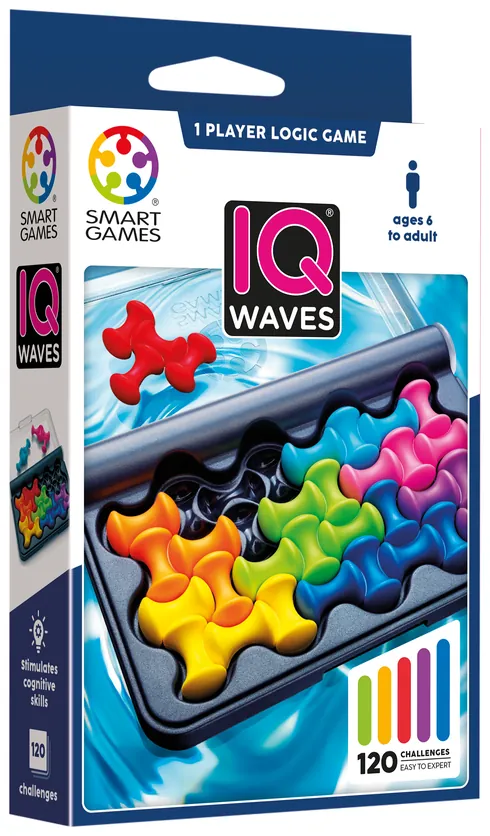
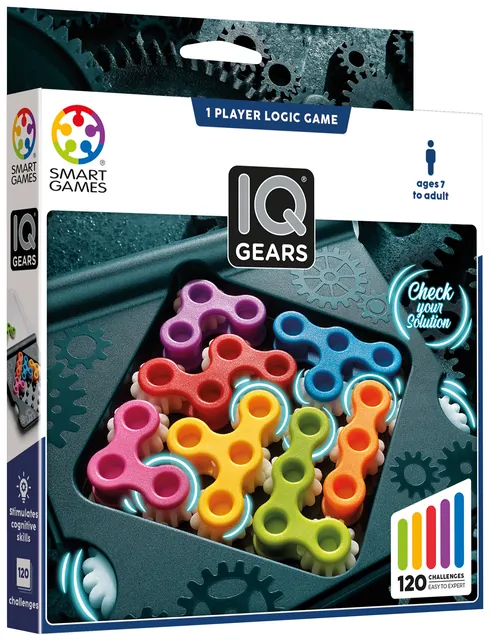
IQ Waves (from age 6, 1 person, flexible playing time) shares the skill area of logic and planning with IQ Puzzler Pro and, like IQ Puzzler Pro, calls for spatial reasoning. Because of the small parts, IQ Waves is less suitable for households with toddlers. IQ Gears (from age 7, 1 person, flexible playing time) calls for spatial reasoning and problem-solving, like IQ Puzzler Pro. In IQ Gears, the task is to fill the board and at the same time complete a chain from left to right. IQ Puzzler Pro suits children from age 6 who like puzzling things out on their own, and playing on the go; it is less suited to children who prefer playing in company.
Sources
Frequently asked questions
What age is IQ Puzzler Pro suitable for?
The game is recommended from age 6. A child is ready when they enjoy puzzling things out alone and like turning pieces around in their head. Anyone who needs large pieces that are easy to grip or prefers playing in company is better served by other games.
How long does a game take and how many people can play?
IQ Puzzler Pro is a game for 1 person and is played solo. The playing time is flexible. The booklet contains challenges in three modes of play: flat, as a pyramid or on the diagonal grid. Each challenge has exactly one solution.
What skills can IQ Puzzler Pro help develop?
The focus is on logic and planning as well as mental rotation. Anyone who fills the tight corners first and sees early on that a cut-off gap can no longer take a piece avoids dead ends. In the pyramid, the lower layer determines what still has room on top.
Is IQ Puzzler Pro also suitable for adults and for playing on the go?
Yes. The case with its transparent lid doubles as the board and is considered easy to take along. According to customer reviews, children, adults and grandparents play it on trips.