How it plays
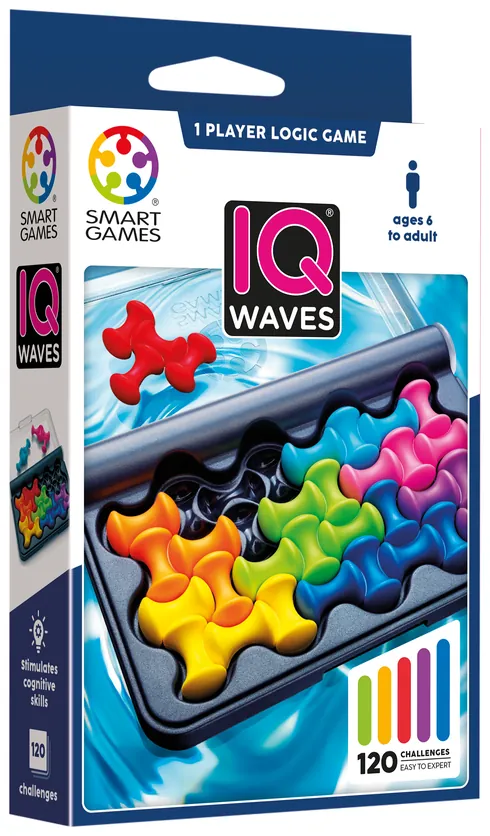
A solo shape puzzle: the game comes with a compact board with a transparent lid, eight coloured wave-shaped pieces with a soft-touch surface and a booklet of challenges with solutions (120 in the edition reviewed). The player chooses a challenge, places the pieces shown on the board as specified and fits in all the others so that the grid is filled. The twist: a piece only fits if the orientation of its waves matches the shapes in the grid. Each challenge has exactly one solution.
What it can help develop
A piece only fits when its waves are oriented correctly. This calls for spatial reasoning: anyone who first turns a piece in their head and compares it with the gap often needs fewer attempts by hand. A quarter turn does not always help; then a different piece or a different spot is needed. Anyone who fills the tight spots first recognises dead ends early and plans ahead. With hard challenges, taking pieces out again is part of the process: testing assumptions, discarding them and starting afresh. This is a chance to practise problem-solving and perseverance.
Especially suitable for
- Children from age 6 who like puzzling things out on their own
- On the go: on the train, in the waiting room, on holiday
- A quiet activity without a screen
Less suitable for
- Children who prefer to play with others
- Households with toddlers: it contains small parts
Our verdict
IQ Waves is a worthwhile choice for children from age 6 who enjoy puzzling things out alone, and as a quiet, screen-free activity on the go. The publisher aims the game at children and adults alike. The twist lies in the waves: a piece only fits if its orientation matches the grid, and that calls for spatial reasoning. Its limitations are its purely solo nature and the small parts, which call for caution in households with toddlers.
Getting started
- Explain the procedure briefly: choose a challenge, place the pieces shown on the board as specified and fit in all the others so that the grid is filled.
- Keep in mind that a quarter turn does not always lead to the solution. If a piece does not fit even when turned, try a different piece or a different spot.
- Fill the tight spots first: this makes dead ends visible early and allows you to plan ahead.
In detail
Variants and player count
SmartGames lists IQ Waves as SG 492 (Pocket Games) for 1 person from age 6. The pocket-sized game includes a compact board with a transparent lid, 8 coloured wave-shaped pieces with a soft-touch surface and a booklet of challenges with solutions. A piece only fits if the orientation of each wave matches the shapes in the grid; a 90° turn can help, but does not have to. Each challenge has only one solution. The publisher’s pages include a warning about small parts. In a blog post from June 2024, SmartGames presents it among its new products for 2024, as suitable for travel and for children and adults.
What reviewers say
No independent review of IQ Waves is on record. The publisher’s awards page does not list IQ Waves (as of October 2026), but it does list IQ Mini with the Spiel Gut Award 2023. According to spielgut.de, IQ Puzzler Pro received the “spiel gut” seal in 2020.
How it compares
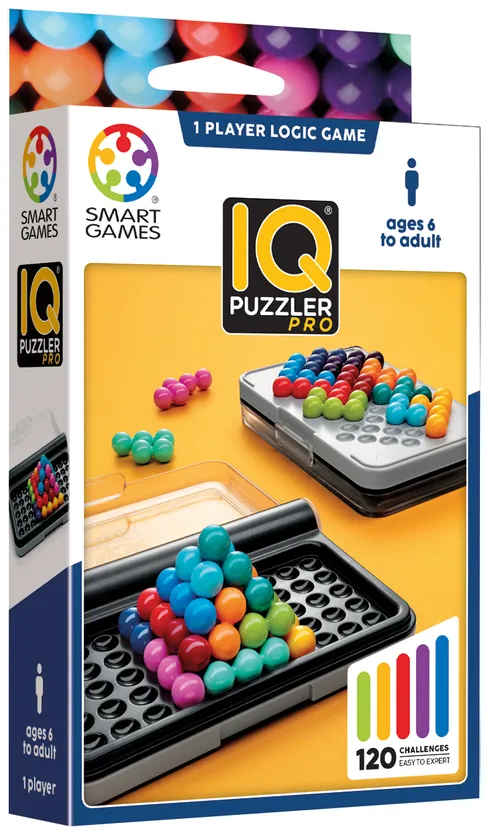
IQ Puzzler Pro (from age 6, 1 person, flexible playing time) has the same skill area, logic and planning, and, like IQ Waves, calls for problem-solving. IQ Puzzler Pro adds mental rotation as well as patience and perseverance. IQ Gears (from age 7, 1 person, flexible playing time) also has this skill area and, like IQ Waves, calls for spatial reasoning and problem-solving. In IQ Gears, the task is to fill the board and at the same time form a chain of gears from left to right. IQ Waves suits children from age 6 who like puzzling things out on their own, and playing on the go. IQ Waves is less suited to children who prefer to play with others and, because of the small parts, to households with toddlers.
Sources
Frequently asked questions
What age is IQ Waves suitable for?
The game is recommended from age 6. A child is ready when they enjoy puzzling things out alone and pay attention to the orientation of the waves. Anyone who prefers playing with others is better served by other games.
How long does a game take and how many people can play?
IQ Waves is a game for 1 person and is played solo. The playing time is flexible. The game comes with eight wave-shaped pieces and a booklet of challenges with solutions, and each challenge has exactly one solution.
What skills can IQ Waves help develop?
The focus is on logic and planning, above all spatial reasoning. Turning a piece in your head first and comparing it with the gap saves attempts. With difficult challenges, taking pieces out again is normal, and that calls for problem-solving and perseverance.
Is IQ Waves suitable for households with toddlers?
The publisher warns of small parts, and the game is recommended from age 6. Households with toddlers should therefore keep the eight pieces out of reach.