How it plays
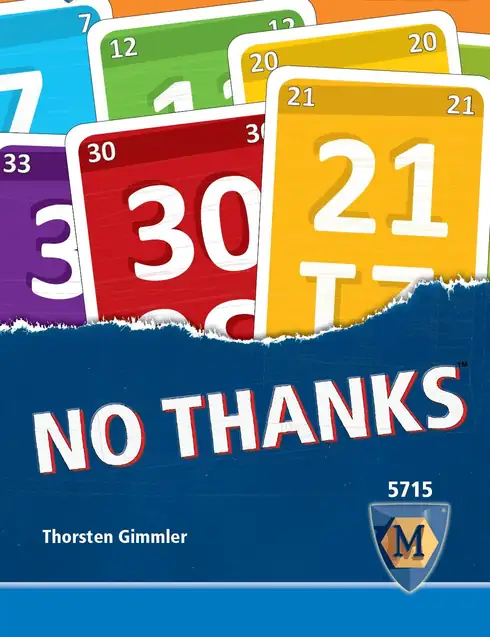
Nine of the 33 number cards (3 to 35) are removed unseen, and the remaining 24 form the draw pile. Everyone starts with a secret supply of tokens. On their turn, players either take the face-up card together with all the tokens on it, or place a token on it and pass it on. A player with no tokens left has to take the card. At the end, each card counts its number as penalty points, but in an unbroken sequence of numbers only the lowest counts. Each token is worth one point in the player’s favour. The player with the fewest penalty points wins.
What it can help develop
At its core is weighing risks: should I take the 26 with five tokens on it now, or refuse once more, and will my supply last? Since nine cards are missing and the supplies are secret, much remains guesswork. Impulse control is needed when managing the tokens: anyone who says “No thanks” by reflex soon runs out of them. And anyone who lets the 15 that fits their own 16 go round the table again risks someone else taking it. On top of this comes simple mental arithmetic.
Especially suitable for
- Children from age 8 who are confident with numbers up to 35
- Family groups of up to seven people
- Short games for a spare moment
Less suitable for
- Children who get annoyed when cards are snatched away from them
- Anyone who already owns an earlier edition
Our verdict
No Thanks! is a worthwhile choice for family groups of three or more people with children from age 8 who are confident with numbers up to 35. The rules are quick to explain and games are short, and between the fun and the annoyance, players are left wanting another game. The first edition, “Geschenkt … ist noch zu teuer!”, was on the Spiel des Jahres recommendation list in 2005. Its limitations are the luck factor and annoyance about cards being snatched away.
Getting started
- When explaining, use an example to show that in an unbroken sequence of numbers, only the lowest card brings penalty points.
- Mention early on that players with no tokens left have to take the card; anyone who refuses straight away every time soon runs out of tokens.
In detail
Variants and player count
According to the 2024 Amigo rules, No Thanks! was designed by Thorsten Gimmler and is intended for 3 to 7 people from age 8, with a playing time of around 20 minutes. Of the 33 number cards (3 to 35), nine are put aside unseen and 24 form the draw pile; there are also 55 tokens, and each player’s supply stays secret. In the scoring, only the lowest value counts in a sequence of numbers, the tokens count as plus points, and whoever has the fewest penalty points wins. According to the rules, this German edition also includes 22 special cards (6 pink, 16 green) as an expansion for experienced players.
What reviewers say
Under the title “Geschenkt … ist noch zu teuer!”, the game was on the recommendation list in 2005, according to Spiel des Jahres; according to Wikipedia, it was nominated for the As d’Or in 2006. In a 2025 review, Reich der Spiele calls No Thanks! quick to explain and highlights the replay value; according to the review, all the players found the special cards unnecessary, but nobody found them bad. Opinionated Gamers reviews the 2024 edition: Dale Yu finds the game more exciting with the special cards, while Mark Jackson finds that they water down the clever base game. According to Wikipedia, reviews call the rules quick to explain and the fun and annoyance factor high; for some reviewers, the luck factor is too high.
How it compares
Port Royal (from age 8, 2 to 5 people, about 20 to 50 minutes) and No Thanks! share the age and the skill areas impulse control as well as logic and planning. Like No Thanks!, Port Royal calls for weighing up risks and impulse control; No Thanks! also has numbers and arithmetic. The Mind (from age 8, 2 to 4 people, about 15 to 20 minutes) shares the age and impulse control with No Thanks!, but also has cooperation and suits families who prefer playing together rather than against each other. No Thanks! suits children from age 8 and family groups of up to seven people; it is less suited to children who get annoyed when cards are snatched away from them.
Sources
- Amigo: No Thanks! rules (PDF, 2024, in German)
- Amigo: No Thanks! (publisher’s page, in German)
- Spiel des Jahres: Geschenkt … ist noch zu teuer! (recommendation list 2005, in German)
- Wikipedia (German): Geschenkt … ist noch zu teuer!
- Wikipedia (German): Liste der Nominierten und Träger des Preises As d’Or – Jeu de l’Année
- Reich der Spiele: review, 2025 (in German)
- Opinionated Gamers: Dale Yu, Review of No Thanks! (2024)
Frequently asked questions
What age is No Thanks! suitable for?
No Thanks! is recommended from age 8. Children who are confident with numbers up to 35 and manage their tokens without refusing by reflex every time are ready; anyone who gets annoyed when cards are snatched away will enjoy it less.
How long does a game take and how many people can play?
A game takes about 20 minutes. The game is for 3 to 7 people, who play against each other, and the player with the fewest penalty points wins. The game is not designed for two players.
What skills can No Thanks! help develop?
It can help develop impulse control, logic and planning as well as numbers and arithmetic. For example, players weigh up whether a high card with many tokens on it is already worth taking, and at the end they add up their penalty points in their heads.
Do you need the special cards in No Thanks!?
No, the base game works without them; in the German edition reviewed, the 22 special cards are intended as an expansion for experienced players. Reviewers are divided: some find that they enrich the game, others consider them unnecessary.