How it plays
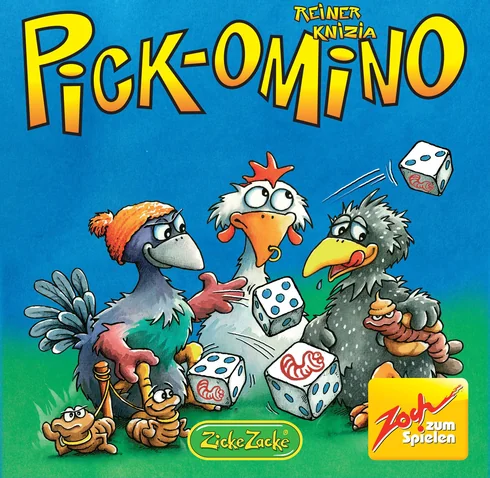
The “grill” holds 16 tiles numbered 21 to 36, each showing one to four worms. Players roll eight dice, on which the worm counts as five, set aside all the dice of one kind and decide: roll again or stop? No kind may be set aside a second time in the same turn. With at least one worm, the total earns the matching tile from the grill or the next lower one; if it exactly matches the top tile of another player, it may be stolen. If the turn fails, the player’s own top tile goes back. The player with the most worms wins.
What it can help develop
Every roll calls for mental arithmetic: three fours make twelve, with a worm seventeen; how much is still needed to reach 27? Then players have to weigh up their options: take four fives, or just the worm, which makes the total valid and leaves more dice to roll? With every roll, the dice and the kinds still available dwindle, and the risk of ending up empty-handed rises. Anyone who already has enough for a good tile has to curb the urge to keep rolling, which calls for impulse control. Stolen worms call for frustration tolerance.
Especially suitable for
- School-age children from age 8 who are consolidating their mental arithmetic
- Mixed groups of up to seven, including with grandparents
- On holiday and on outings: the box is small
Less suitable for
- Children who find it hard to cope with having worms stolen
- Pairs who always play as two: stealing hardly comes into play
Our verdict
Pickomino is a worthwhile choice for families with school-age children who need to consolidate their mental arithmetic, and for mixed groups with grandparents. The rules are quick to explain, and the small box fits into a suitcase when you go on holiday. Its limitations are the high luck factor, the limited strategic depth and the stealing, which can upset sensitive children.
Getting started
- Show the dice rule with an example: three fours make 12, with a worm 17, with two fives 27. Each kind may only be taken once per turn.
- Before each further roll, check briefly whether a worm has already been set aside. Without a worm, the turn fails and the player’s own top tile goes back on the grill.
- Explain beforehand that a tile can only be stolen if the total exactly matches another player’s top tile. This shows children when their own tile is in danger.
In detail
Variants and player count
Reiner Knizia’s game was published by Zoch in 2005 as “Heckmeck am Bratwurmeck”, for 2 to 7 people. The components are eight dice, on which a worm replaces the six and counts as five points, and 16 tiles numbered 21 to 36. The tiles show one to four worms: 21 to 24 have one, 33 to 36 have four. The 2014 Zoch rules are available in German, English, French and Italian; in France, Gigamic distributes the game as Pickomino.
What reviewers say
Reich der Spiele finds it simple, quick and luck-driven; according to the review, it drags a little with two, and at least three people are recommended. Spieletest.at highlights the few rules and the fact that players stay involved through the failed rolls of others; according to the review, it is a mean game with a high luck factor. Die besten Familienspiele calls the rules very simple and the game good for several generations; according to the review, it is most fun with four to seven people. Ludowelt praises the high-quality components, which are easy for children to handle, and the entertainment value, but criticises a great deal of luck at times. Cliquenabend appreciates rules that are quick to explain and the compact box, but misses strategic depth, given the large amount of luck of the dice.
How it compares
Pickomino (from age 8, 2 to 7 people, 20 to 30 minutes) and Can’t Stop (from age 7, 2 to 4 people, about 30 minutes) have the same three skill areas. These are numbers and arithmetic, logic and planning as well as impulse control. In Can’t Stop, too, players decide whether to keep rolling or to stop. Can’t Stop suits school-age children who enjoy taking risks, but is less suited to children who find lost turns hard to cope with. No Thanks! (from age 8, 3 to 7 people, about 20 minutes) has the same three skill areas and, like Pickomino, has room for up to seven people, but cannot be played with two. No Thanks! is suitable for short games for a spare moment; anyone who gets annoyed when cards are snatched away is less well served by it.
Sources
- Zoch: Heckmeck am Bratwurmeck (publisher’s page, in German)
- Zoch: rules, 2014 (PDF)
- Wikipedia (German): Heckmeck am Bratwurmeck
- Wikipedia (French): Pickomino
- Gigamic: Pickomino (publisher’s page, in French)
- Reich der Spiele: review (in German)
- Spieletest.at: review (in German)
- Die besten Familienspiele: review (in German)
- Ludowelt: review (in German)
- Cliquenabend: review (in German)
Frequently asked questions
What age is Pickomino suitable for?
The game is recommended from age 8. A child is ready when they can add numbers up to about 36 in their head and can cope with having a tile snatched away from them. Anyone who finds that difficult should wait a little longer.
How long does a game take and how many people can play?
A game takes about 20 to 30 minutes. The game is for 2 to 7 people, who play against each other, and whoever has the most worms at the end wins. According to reviews, it drags with two players; it is most fun with four to seven.
What skills can Pickomino help develop?
The game can train numbers and arithmetic, logic and planning as well as impulse control. Anyone who rolls three fours and a worm has 17 and works out how much is still needed to reach 27. Whether to keep rolling even though the dice and available kinds are dwindling has to be weighed up.
Is Pickomino fun for adults too?
According to reviews, groups spanning several generations have fun with it. Adults should be aware that there is a lot of luck of the dice involved and that the strategic depth remains limited.