How it plays
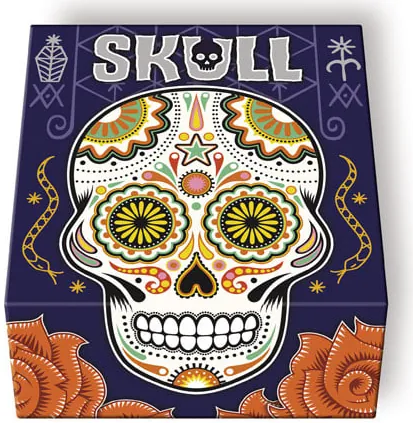
Everyone has four discs with identical backs: three flowers and one skull. Everyone lays one face down, then, taking turns, players either add another on top or announce how many discs on the table they can turn over without hitting a skull. The others raise the bid or pass. Whoever bids highest first turns over their own discs, then those of other players. Two successful challenges win the game, and so does being the last player left. A skull costs a disc; anyone left without discs is out.
What it can help develop
Skull calls above all for perspective-taking: whoever holds the highest bid has to turn over their own discs first, so they have probably laid flowers, or want others to believe exactly that. Players practise reading bids, hesitation and facial expressions. Weighing risks comes in too: how many of the discs on the table could be skulls, and when is it wiser to pass? Impulse control is needed for the poker face and to resist hasty bids.
Especially suitable for
- Families with children from age 10 who like to bluff
- Groups of four to six people
- Short games for a quick break: few components, quick to explain
Less suitable for
- Children who dislike deceiving others, even in a game
- Groups of three: best with four or more people
Our verdict
Skull is a worthwhile choice for families whose children from age ten enjoy bluffing, and for groups of four or more people. Its strength: the rules are quickly explained, hardly any components are needed and the suspense grows with every disc revealed. Its limitations are the luck factor, three-player games and children who dislike deceiving others.
Getting started
- Use a house rule against the frustration of being knocked out: anyone who is almost out gets an extra flower for one round.
- Demonstrate revealing once: whoever made the highest bid first turns over their own discs, then the top disc from other players’ stacks, one at a time.
- Play with four or more people if possible, because according to reviews it is less enjoyable with three.
In detail
Variants and player count
According to Wikipedia, the game by Hervé Marly was first published in 2011 as “Skull & Roses” by lui-même; a second edition followed in 2013 as “Skull” from lui-même together with Asmodee. According to the Spiel des Jahres database, a new edition under the name “Skull” has been available from Space Cowboys since 2024 (distributed by Carletto). According to the English rules of the current edition, each set includes a mat and four discs: three flowers and one skull. Cliquenabend thinks the game is best with four or more players; Rezensionen für Millionen finds it better suited to large groups who enjoy deceiving each other than to small ones.
What reviewers say
According to the Spiel des Jahres database, “Skull & Roses” was on the recommendation list in 2011; according to Wikipedia, it also won the As d’Or – Jeu de l’Année 2011. Cliquenabend says the rules are quick to explain and the components sparse, but sees a very high luck factor alongside some strategic options and mentions the poker face. In Rezensionen für Millionen, Udo Bartsch rates it very highly in the right group and names judging the other players’ behaviour and the showdown when discs are revealed. Eurogamer describes suspense that grows with each reveal. In the afterword of the French rules, the designer writes that players may say anything in Skull, even the truth.
How it compares
The Fox in the Forest (from age 10, 2 people, about 30 minutes) shares with Skull the skill areas of impulse control as well as logic and planning. In The Fox in the Forest, impulse control is needed because the sure trick is tempting and easily leads to greed. The Fox in the Forest suits a calm duel between a parent and a child. The Mind (from age 8, 2 to 4 people, about 15 to 20 minutes) shares with Skull the areas of impulse control and cooperation. In The Mind, as in Skull, players put themselves in the others’ shoes, because a long silence can mean that nobody is holding a card in between. The Mind suits families who prefer playing together rather than against each other; The Mind is less suited to restless groups.
Sources
- Space Cowboys: Skull rules (PDF)
- Space Cowboys: Skull rules (PDF, in French)
- Spiel des Jahres: Skull & Roses (jury, in German)
- Wikipedia (German): Skull & Roses (Spiel)
- Wikipedia (French): As d’or - Jeu de l’année
- Cliquenabend: Skull & Roses, review (in German)
- Rezensionen für Millionen: Skull & Roses, review (in German)
- Eurogamer: Skull and Roses, review
Frequently asked questions
What age is Skull suitable for?
Skull is recommended from age 10. A child who enjoys bluffing and can read the others at the table without giving themselves away is ready. Anyone who finds deceiving others difficult, even in a game, is less well served by it.
How long does a game take and how many people can play?
A game takes about 15 to 30 minutes. The game is for 3 to 6 people, who play against each other, ideally with four or more. Whoever succeeds in two challenges or is the last one left in the game wins.
What skills can Skull help develop?
Skull can train impulse control, logic and planning as well as putting yourself in the other players’ shoes. Players interpret bids, hesitation and facial expressions, estimate how many discs could be skulls and keep a poker face instead of bidding too hastily.
Do you need to be good at lying?
No, what matters is judging the others. The rules stress that players may say anything, even the truth. Anyone who still feels uncomfortable deceiving others will enjoy a different game more.