How it plays
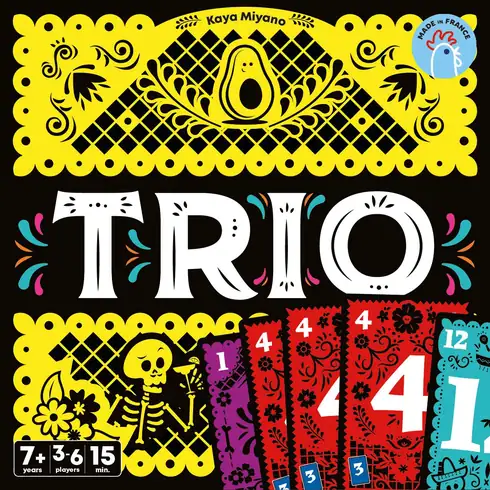
There are three cards each of the numbers 1 to 12. Everyone holds the same number of cards secretly in their hand, sorted in ascending order; the rest lie face down in the middle. On their turn, players reveal card after card: one from the middle or the lowest or highest card of a hand, including their own. If a number differs, all the cards go back and the turn ends; three of a kind make a trio. In the base game, whoever collects three trios or the trio of sevens wins.
What it can help develop
Trio calls above all on working memory: which number who has shown and what lies in the middle have to be retained and updated across turns. Logical reasoning comes in too: with sorted hands, a four as the lowest card shows that this hand contains no ones, twos or threes. Impulse control is needed because every failed attempt helps everyone: anyone who turns over a card reflexively or gives themselves away through their facial expression helps the next player.
Especially suitable for
- Children from age 7 who enjoy remembering and working things out
- Families looking for a quick game to end the evening
- Guests with little gaming experience
Less suitable for
- Children who get annoyed about missed trios
- Groups of three: trios are often too easy to get
Our verdict
Trio is a worthwhile choice for families with children from age 7 and for newcomers to games who are looking for a short game to end the evening. It calls for memory and working things out with few rules, and it won the As d’Or in 2024. Its limitations are that chance often decides in small groups, the two levels hardly differ, and missed trios can be annoying.
Getting started
- To start, choose the mild version with three trios; the spicy version requires two linked trios but, according to reviews, is hardly any harder.
- Before the first round, say that the trio of sevens wins immediately; according to reviews, it keeps everyone in the race until the end.
- Explain that even a failed attempt provides information, because everyone sees the revealed cards.
In detail
Variants and player count
According to Cocktail Games, Trio is by Kaya Miyano, illustrated by Laura Michaud, and comprises 36 cards. According to the rules, everyone receives the same number of cards in hand: 9 with three players, 7 with four, 6 with five and 5 with six. There are two modes, called “simple” and “picante” by Cocktail Games and “mild” and “pikant” in the review round-up by the Spiel des Jahres jury, as well as a team rule. According to the rules, whoever collects three trios wins in “simple”, and whoever collects two linked ones wins in “picante”; the trio of sevens always wins.
What reviewers say
The Spiel des Jahres jury put Trio on the recommendation list in 2024. According to yesicannes.com, it won the As d’Or – Jeu de l’Année 2024, and according to Fairplay it took second place in the À la carte award of Fairplay magazine in 2024, behind “Mischwald”. In the jury’s review round-up, Franke praises the trio of sevens, which means that nobody can sit back, and sees a high luck factor in small groups. Schrapers sees memory, probability and deduction complementing each other and finds no relevant difference between the two modes. Rezensionen für Millionen writes that chance often decides, that with three players and nine cards in hand trios are child’s play, and that the trio of sevens keeps the game exciting until the end.
How it compares
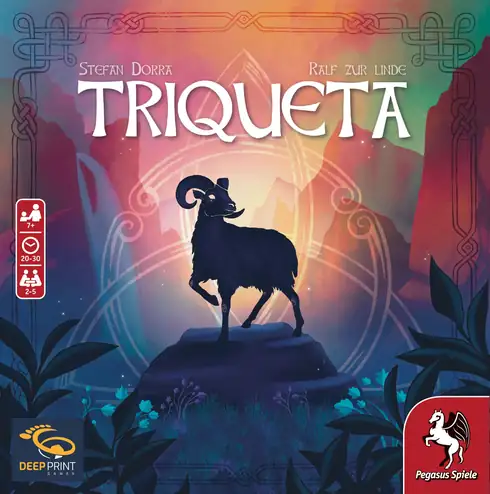
Can’t Stop (from age 7, 2 to 4 people, about 30 minutes) shares with Trio the skill areas of impulse control as well as logic and planning and, like Trio, calls for impulse control: stopping in time instead of having another go. In Can’t Stop, weighing risks and mental arithmetic come in too; children who find it hard to cope with wasted turns are less well served there. Triqueta (from age 7, 2 to 5 people, about 20 to 30 minutes) shares the age and the skill areas of impulse control as well as logic and planning with Trio; Trio also covers memory. Trio suits children from age 7 who enjoy remembering and combining, and families looking for a quick game to end the evening. Trio is less suited to children who get annoyed about missed trios and to groups of three, in which trios are often too easy to get.
Sources
- Cocktail Games: Trio (publisher’s page, in French)
- Cocktail Games: Trio rules (PDF, in French)
- Spiel des Jahres: Trio (jury, in German)
- Spiel des Jahres: Kritikenrundschau Trio (review round-up, in German)
- Games We Play: Trio (in German)
- Rezensionen für Millionen: Trio (in German)
- yesicannes.com: Trio, As d’Or 2024 (in French)
- Fairplay: À-la-carte-Kartenspielpreis (in German)
Frequently asked questions
What age is Trio suitable for?
The recommended minimum age is 7. Children who enjoy keeping numbers in their head and drawing conclusions from them are ready; the game also suits newcomers to the games table. Anyone whose mood is quickly spoiled by a missed trio will find it harder.
How long does a game take and how many people can play?
A game takes about 15 minutes. The game is for 3 to 6 people, who play against each other; in the base game, whoever collects three trios or the trio of sevens wins.
What skills can Trio help develop?
It can help develop impulse control and memory as well as logic and planning. If the lowest card of a sorted hand shows a four, there can be no lower number in that hand. Anyone who reveals too hastily or gives something away through their reaction helps the other players.
How many people does Trio work best with?
According to one review, with four rather than three. With three, each person has nine cards in hand, trios fall into players’ laps quickly, and in small groups chance plays a bigger role.