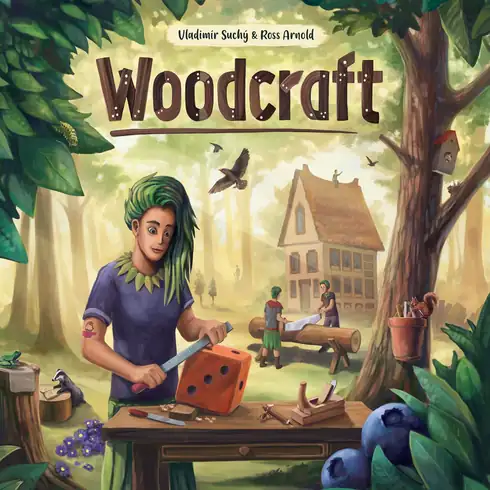
How it plays
Six-sided dice in green, yellow and brown represent the wood, and the exact number of pips matters. Taking turns, players choose one of seven actions on the action wheel, such as buying wood or hiring helpers; the longer no one chooses an action, the bigger the bonus it brings. Dice can also be sawn apart, glued together and upgraded. Orders call for exact colours and values; if they lie unfulfilled for a long time, the reward shrinks. After 14 rounds (13 with four players), whoever has the most points wins.
What it can help develop
Woodcraft is above all a planning exercise: which action now, which one later, and which order has to be completed before its reward shrinks? Added to this is a number puzzle: a six can be sawn into a four and a two, and a three and a two can be glued into a five. For each order, players work backwards to calculate which steps are needed. If someone snatches away the order a player was aiming for, it is time to replan.
Especially suitable for
- Teenagers from age 12 with gaming experience who enjoy puzzling things out
- Parents and teenagers on long strategy evenings
- Solo players: a solo variant is included
Less suitable for
- Beginners: according to the publisher, an expert game
- Impatient groups: long pauses for thought and little interaction
Our verdict
Woodcraft is a worthwhile choice for teenagers from age 12 with plenty of gaming experience and for parents who want to spend an evening working on a puzzle of dice and numbers. In 2023 it came sixth in the Deutscher Spiele Preis and received the Gouden Ludo in Flanders as an expert game. Its limitations are that the publisher sees it as an expert game, and reviews mention a noticeable learning curve, long pauses for thought, luck in the orders on display and little interaction.
Getting started
- Show with examples beforehand how sawing and gluing work: sawing splits a die into smaller ones of the same colour with the same total, and gluing combines two into their sum.
- Keep an eye on the orders, because in each income phase the order cards slide down a row until the reward turns into a penalty.
- Watch the action wheel: the longer no one chooses an action, the bigger its bonus becomes.
In detail
Variants and player count
The German edition from Pegasus is intended for 1 to 4 people from age 12 and is classified as an expert game. Pegasus gives a playing time of 80 to 150 minutes, the original publisher Delicious Games 45 to 150. According to the German rules, there are 14 six-sided dice each in green, yellow and brown, which represent the wood. The game is played over 14 rounds, or 13 with four players. To get started, the rules show a starting section of the action wheel, and a solo variant with a solo deck is included.
What reviewers say
The Spielkultisten praise a tactical dice puzzle with a new kind of dice manipulation, a successful thematic integration and an interesting choice of actions. They criticise games that are at times very ponderous, with increased downtime, an occasional influence of luck and little interaction; orders and helpers can, however, be snatched away. Meeple Mountain finds that the mechanisms mesh and create a lot of strategic depth, but criticises the luck in the orders on display, unclear points in the rules and a noticeable learning curve. Ludovox writes that the game hardly forgives mistakes and that there is no catch-up mechanism. In the Deutscher Spiele Preis 2023, Woodcraft came sixth, and in Flanders it won the Gouden Ludo 2023 as an expert game.
How it compares
The Taverns of Tiefenthal (from age 12, 2 to 4 people, about 60 minutes) shares with Woodcraft the skills profile of logic and planning as well as numbers and arithmetic. In The Taverns of Tiefenthal, players plan their expansion ahead and calculate constantly, and cognitive flexibility is needed when the dice do not fall as hoped. The Taverns of Tiefenthal suits older children and teenagers with gaming experience, and is less suited to optimisers who are bothered by luck of the dice and to impatient children in groups of four. Targi (from age 12, 2 people, about 60 minutes), like Woodcraft, calls for planning ahead, plus perspective-taking, but is a pure two-player game. Woodcraft, by contrast, can be played by up to four people or alone with the solo variant, but according to the publisher Pegasus it is an expert game.
Sources
- Pegasus Spiele: Woodcraft (product page, in German)
- Delicious Games: Woodcraft (publisher’s page)
- Pegasus Spiele: Woodcraft rules (PDF, in German)
- Spielkultisten: review (in German)
- Meeple Mountain: review
- Ludovox: review (in French)
- Wikipedia (German): Deutscher Spielepreis
- Wikipedia: Deutscher Spiele Preis
- Wikipedia (Dutch): Gouden Ludo
Frequently asked questions
What age is Woodcraft suitable for?
The recommended minimum age is 12. Teenagers with gaming experience who enjoy puzzling things out, juggling numbers and sticking with long strategy games are ready. For beginners, it is classified as an expert game.
How long does a game take and how many people can play?
A game takes about 80 to 150 minutes. The game is for 1 to 4 people, who play against each other, with a solo variant for playing alone; one review names three as probably the best number of players. After 14 rounds, or 13 with four players, whoever has the most points wins.
What skills can Woodcraft help develop?
It can help develop logic and planning as well as numbers and arithmetic. Sawing splits a die into smaller ones of the same colour with the same total of pips, and gluing joins two together. For each order, the necessary steps have to be worked out backwards from the goal.
Is Woodcraft suitable for beginners?
Not really. The publisher classifies it as an expert game, and reviews mention a noticeable learning curve. For the first game, the rules provide a starting section of the action wheel, shown in an illustration.