How it plays
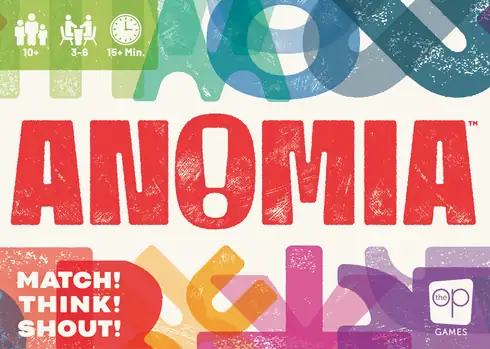
Taking turns, each person turns over a card from the draw pile and places it on their own pile. Each card shows a category, such as a type of sport, and one of eight symbols. If the top cards of two people show the same symbol, a duel follows: both call out an example from the category on the opponent’s card. Whoever answers correctly first takes the other person’s top card; the card underneath can trigger the next duel straight away. When the draw pile is empty, whoever has won the most cards wins.
What it can help develop
The original title, Anomia, is the technical term for word-finding difficulties. In the game, it is the ordinary mental blank that shows up: under time pressure, not a single kind of fruit comes to mind. Above all, the game calls for word retrieval from a category. At the same time, players have to keep an eye on all the piles so that matching symbols stand out immediately: processing speed. Because every duel requires the category on the other player’s card, players have to switch and block out their own: cognitive flexibility.
Especially suitable for
- Articulate children from age 10
- Family gatherings with grandparents
- Groups who like to play loud and fast
Less suitable for
- Children who still read slowly
- Players who dislike time pressure and noise
Our verdict
Anomia is suitable for children from age 10 who find that words come easily, and for family gatherings with grandparents where things are allowed to get loud and lively. The rules are simple, the shouting over one another is praised, and the original Anomia was named best party game at the UK Games Expo 2014. Its limitations are slow readers, a dislike of time pressure and noise, and its strong dependence on the group.
Getting started
- Demonstrate a duel with an example beforehand. If two top cards show the same symbol, both players call out a suitable word for the category on the other card, and whoever answers correctly first takes the card.
- Point out chain duels: after a duel, the new top card can immediately trigger the next one.
- Ask beforehand whether everyone can cope with time pressure and loud chaos, because the game is not for everyone.
In detail
Variants and player count
According to the KOSMOS product page, the German edition, “Blitzdings”, includes 200 cards, each showing a category and one of eight symbols; it is for 3 to 6 people from age 10. According to Wikipedia, Anomia was designed by Andrew Innes and first published in 2009 by Anomia Press. As a variant, the original publisher, Anomia Press, suggests giving younger children just one category for the whole game, such as an animal. The younger children then only watch the symbols and their own category, while older players keep answering to their opponent’s card.
What reviewers say
According to Wikipedia, Anomia received the Mensa Select award in 2010 and was named Best Party Game at the UK Games Expo in 2014. Also according to Wikipedia, Wirecutter praises the chaotic shouting over one another and the pace, and Polygon praises the simple rules. Slate (Noel Murray, 2021) describes Anomia as a game for children, grandparents and adults, with funny wrong answers and fun across generations. Global News calls Anomia easy to play and family-friendly. Lautapeliopas reviews the Finnish edition, Sanasota, and finds it easy to explain, but not to everyone’s taste and dependent on the group; according to Lautapeliopas, it is hardly playable with children, and the game requires reading.
How it compares
Scrabble Original (from age 10, 2 to 4 people, about 50 to 90 minutes) shares the age, the skill area of language and word retrieval with Anomia; Scrabble Original adds planning ahead and mental arithmetic. Scrabble Original is less suited to impatient players who dislike waiting. Pass the Bomb (from age 8, 2 to 12 people, about 30 minutes) shares the skill areas of language as well as perception and speed with Anomia and, like Anomia, calls for word retrieval and processing speed. Pass the Bomb adds impulse control. Anyone who freezes under time pressure or avoids noise is less well served by Pass the Bomb, as by Anomia. Anomia suits articulate children from age 10, family gatherings with grandparents and groups who like to play loudly and fast; it is less suited to children who still read slowly.
Sources
Frequently asked questions
What age is Anomia suitable for?
Anomia is recommended from age 10. A child is ready when examples from a category come to them quickly under time pressure and they do not fall silent as soon as others shout over them. It is less suitable for children who are still slow readers.
How long does a game take and how many people can play?
A game takes about 20 to 30 minutes. The game is for 3 to 6 people, who play against each other; at the end, whoever has collected the most cards wins.
What skills can Anomia help develop?
The skills profile lists language, perception and speed as well as flexibility. In a duel, players need a suitable word for the category on the other player’s card at lightning speed, such as a type of sport, while keeping their own category out of their mind.
Do you need to be able to read well?
Yes, the game requires reading: each card shows a category, and speed counts in a duel. Slow readers are therefore at a disadvantage, and one review finds the game hardly playable with children.