How it plays
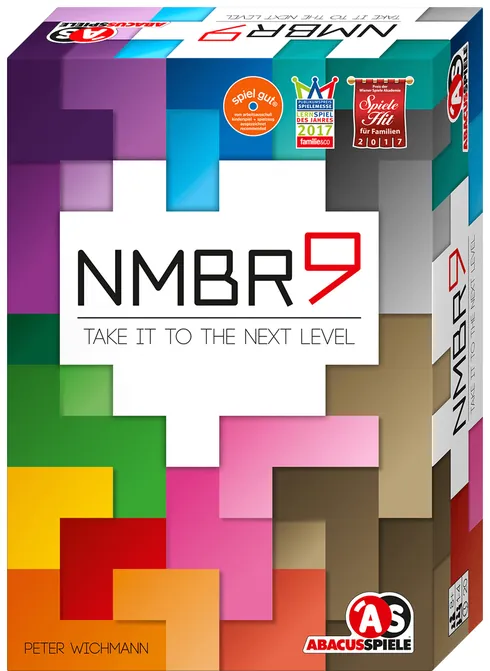
Everyone builds their own layout from an identical set of cardboard tiles shaped like digits. In each of the 20 rounds, a number card is turned over and everyone places the matching tile at the same time, rotated any way they like, digit facing up. On a level that already has a tile, the new tile must border on an existing one. A tile placed higher up must rest completely on at least two tiles, with no overhang and without covering a gap. Each tile scores its digit times its level; tiles on the table count zero. The most points win.
What it can help develop
NMBR 9 calls above all for spatial reasoning: in which rotation does the angular digit fit without a gap blocking further building? Trying things out is allowed, but players have to imagine where later tiles will find room. Planning ahead comes in too: the bottom level scores nothing but supports everything above it. Each number appears exactly twice; anyone who keeps count knows what is still to come. The arithmetic comes in during scoring: digit times level, for example 8 × 2 = 16.
Especially suitable for
- Puzzle fans from age 8 who like fitting shapes together
- Short games in which everyone plays at the same time
- Children who also want to play on their own
Less suitable for
- Groups looking for interaction and direct competition
- Groups whose members puzzle at very different speeds
Our verdict
NMBR 9 is a worthwhile choice for puzzle fans from age 8 and for families who like short games in which everyone puzzles at the same time, and it also works for playing alone. The rules are quick to explain, and after one game players often want a rematch. In 2017, it received the “Spiele Hit für Familien” and “Lernspiel des Jahres” awards. Its limitations are the lack of interaction, the possibility of copying and little variety in the long run.
Getting started
- Trying things out is allowed as long as a tile has not been placed for good; after that, it is not moved again.
- Anyone who keeps track of which cards have already come up can plan better, because each number appears exactly twice.
In detail
Variants and player count
According to the rules on spielezar.ch, the game includes 80 number tiles (the digits 0 to 9, eight of each) and 20 number cards (two per digit). The designer is Peter Wichmann, and the game was published by Abacusspiele in 2017. The game is played over 20 rounds, in each of which everyone places the same tile at the same time. Each tile scores its number times its level, for example 8 × 2 = 16; level 0 scores no points. In the solo game, the player aims to beat their own record; according to these rules, 100 points or more count as excellent.
What reviewers say
The publisher’s page of Abacusspiele names the seals “Spiele Hit für Familien 2017” and “Lernspielpreis”; according to Wikipedia, the game was named best educational game at the Stuttgart games fair in 2017. InFranken praises the simple rules and short games that make players want a rematch; the lack of interaction, the possibility of copying and, in the long run, little depth are criticised. Board Game Quest calls it easy to explain and puzzle-like, complains about the lack of interaction and the possibility of copying early placements, and would like more variability. Dale Yu finds it easy to explain, describes the simultaneous puzzling and the trade-off between building a foundation and building higher early on, and criticises the lack of interaction.
How it compares
Ubongo (from age 8, 1 to 4 people, about 25 minutes), like NMBR 9, calls for spatial reasoning and shares logic and planning; Ubongo also has perception and speed, while only NMBR 9 has numbers and arithmetic. Honshu (from age 8, 2 to 5 people, about 30 to 40 minutes), like NMBR 9, calls for spatial reasoning and planning ahead, but has only logic and planning as a skill area and is not a solo game. NMBR 9 suits puzzle fans from age 8 who like fitting shapes together, short games in which everyone plays at the same time, and children who also want to play alone. NMBR 9 is less suitable for groups looking for interaction and direct competition.
Sources
Frequently asked questions
What age is NMBR 9 suitable for?
NMBR 9 is recommended from age 8. Children who like fitting shapes together and can do simple multiplication when scoring are ready; anyone expecting a game with direct competition is less well served.
How long does a game take and how many people can play?
A game takes about 20 minutes. The game is for 1 to 4 people: everyone builds their own layout at the same time, and the game can also be played alone.
What skills can NMBR 9 help develop?
It can help develop logic and planning as well as numbers and arithmetic. For example, players have to think ahead about where further tiles will still fit, and when scoring, the digits are multiplied by the level.
Do you need to be good at arithmetic to play NMBR 9?
Only when scoring: there, each tile counts digit times level, for example 8 times 2 equals 16. Placing the tiles itself calls for spatial imagination, not arithmetic.