How it plays
Each player has four face-down cards (values 0 to 13) in front of them and may look at two of them once. On their turn, players swap the top card of the draw pile or the discard pile for one of their own cards, or discard the card from the draw pile. When drawn from the pile and discarded, sevens and eights let players look at one of their own cards, nines and tens at someone else’s, and elevens and twelves allow a blind swap. Anyone who believes they are in the lead calls “Cabo” instead of drawing; the others then have one more turn. Play continues until someone goes over 100 points; the lowest total wins.
What it can help develop
Above all, Cabo Deluxe Edition calls on working memory, which has to be updated constantly: which value is where, what did the last swap change, what did the other player’s card show? Before calling, players estimate their own total, including the unknown cards, and weigh up the risk. Anyone who calls too early without being in the lead receives penalty points; waiting instead of calling rashly requires impulse control. Along the way, players compare and add up numbers.
Especially suitable for
- Children from age 8 who like working with numbers
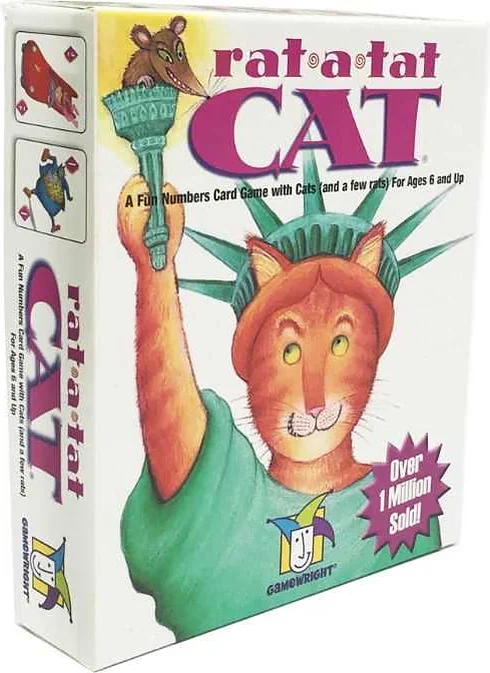
- Families who have found Rat-a-Tat Cat too easy
- Mixed groups of teenagers and adults
Less suitable for
- Children who cannot yet add up confidently
- Anyone who shies away from luck and nasty swaps
Our verdict
Cabo Deluxe Edition is a worthwhile choice for eight-year-olds and older children who are confident with numbers, and for families who have outgrown Rat-a-Tat Cat. The rules are simple and the rounds short, and according to GeekDad there is a mental challenge behind the childlike look. Its limitations are that children who cannot yet add up confidently will struggle and that chance and nasty swaps are part of the game. In addition, in the edition reviewed, the rule dropping a player back to 50 at exactly 100 points drags games out.
Getting started
- Emphasise that the actions only apply to cards that are drawn from the pile and then discarded.
- Make clear that a card taken from the discard pile cannot simply be put down again but must be swapped for one of your own.
- Mention the penalty for calling: whoever says “Cabo” without having the lowest total receives penalty points, and the others still have one more turn after the call.
In detail
Variants and player count
According to Smiling Monster Games, the German edition is a card game for 2 to 5 people from age 8 with a playing time of about 30 minutes; the aim is the lowest total among the cards laid out. The following details come from the English-language website cabogame.com, not from the rules of the German edition. Players lay out four cards face down and look at two of them once. On their turn, players swap the card from the draw pile or discard it, either as an action card or without an action; instead of drawing, a player can call “Cabo”, and then everyone else has one more turn. Anyone who calls “Cabo” without having the lowest total receives penalty points. The game ends when someone goes over 100 points; at exactly 100, a player drops back to 50. In the rules text of the original 2010 edition, Peek (7, 8) lets players look at one of their own cards and Spy (9, 10) at someone else’s. Swap (11, 12) swaps one of their own cards blind for someone else’s. According to Wikipedia, the game is by Melissa Limes and Mandy Henning (2010).
What reviewers say
No review of the German edition is listed. Father Geek reviews the first edition and finds simple rules with more strategy than expected, naming memory, arithmetic and risk. Father Geek calls it good for counting and adding up; on the critical side, according to Father Geek, dropping back to 50 at exactly 100 points makes games longer. Wired (GeekDad, January 2011) considers the rules deep enough for a mental challenge; paraphrased, the game is not a children’s game, but looks like one.
How it compares
Rat-a-Tat Cat (from age 6, 2 to 6 people, about 20 minutes) shares the skill areas of memory as well as numbers and arithmetic with Cabo Deluxe Edition, but has no impulse control. Hanabi (from age 8, 2 to 5 people, about 25 minutes) has the same minimum age and the same number of players as Cabo Deluxe Edition (from age 8, 2 to 5 people, about 30 minutes). Hanabi also shares the skill area of memory with Cabo Deluxe Edition and adds cooperation as well as logic and planning.
Sources
Frequently asked questions
What age is Cabo Deluxe Edition suitable for?
Cabo Deluxe Edition is recommended from age 8. A child is ready when they can confidently add up values from 0 to 13, remember what is where and wait instead of rashly calling “Cabo”. Anyone who shies away from chance and nasty swaps will enjoy it less.
How long does a game take and how many people can play?
A game takes about 30 minutes, while a single round takes only around 5, according to one review. The game is for 2 to 5 people, who play against each other. It ends as soon as someone goes over 100 points, and whoever then has the fewest points wins.
What skills can Cabo Deluxe Edition help develop?
The skills profile lists memory, impulse control as well as numbers and arithmetic. Children remember which value is where and estimate their total, including the unknown cards; anyone who calls “Cabo” rashly without being in the lead receives penalty points.
Is Cabo Deluxe Edition a children’s game?
It looks childlike, but according to GeekDad it is mentally demanding. Another review praises simple rules with more strategy than expected. Players can read the others from their moves and the cards they choose.