How it plays
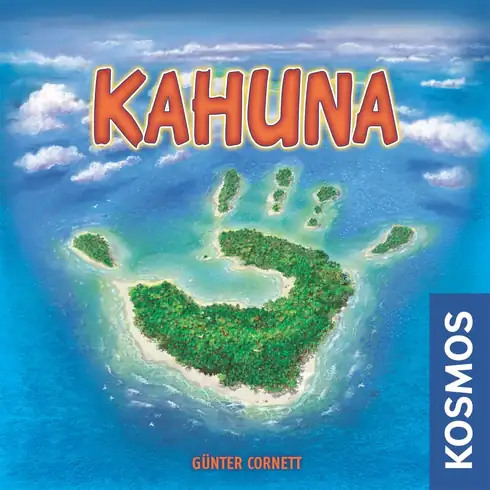
Two priests compete for twelve islands connected by lines. An island card allows a player to place a stick on a free line of that island; two matching cards remove an opponent’s stick. Whoever holds more than half of an island’s lines places their Kahuna stone on it, and all the opponent’s sticks there disappear, which can also cost the opponent neighbouring islands. Players may play as many cards as they like but draw only one. There are three scorings, and the player with the most points wins: the island majority is worth first 1 point, then 2 points and finally as many points as the lead in islands.
What it can help develop
Kahuna rewards players who think several moves ahead: a stick in the right place secures an island, the opponent’s sticks there disappear and suddenly the other player loses the neighbouring island too. Playing through such chain reactions in your head calls for planning and working memory. Because only one card comes in at a time, it can pay to save up cards for a multiple move. And because a single move can overturn the whole network, cognitive flexibility is needed: letting go of plans, reassessing, changing course.
Especially suitable for
- Children from age 10 who enjoy tactics
- Couples and parent-child duels
- Children who like to think several moves ahead
Less suitable for
- Larger family groups: it is for two players only
- Children who cope badly with falling behind and bad luck with the cards
Our verdict
Kahuna is a worthwhile choice for couples and for duels between parents and children from age 10 who enjoy tactics and plan several moves ahead. The rules are short and clear, and the game is calm and tactical. It was on the selection list of the Spiel des Jahres in 1999 and won the Super As d’Or in France in 2000. Its limitations are the strict two-player format and the luck of the draw, as it is hard to make up a clear deficit.
Getting started
- Show the chain reaction first: whoever holds more than half of an island’s lines places the Kahuna stone there, and all the opponent’s sticks on that island disappear. This can also cost the opponent neighbouring islands.
- Explain that players may play any number of cards but draw only one, with no more than five cards in hand. Saving up cards allows a multiple move later.
- Name the three scorings beforehand: the island majority is worth first 1 point, then 2 points and finally as many points as the lead in islands.
In detail
Variants and player count
According to the rules, two people compete for twelve islands; the game includes 24 island cards, two for each island. Players may play any number of cards but draw only one, and may hold no more than five cards. There are three scorings: the first is worth 1 point, the second 2 points, and in the last the difference counts. As a handicap, the weaker player places one to three sticks freely after the cards are dealt.
What reviewers say
The Spiel des Jahres jury calls the simple rule the basis for a multi-layered game. According to Wikipedia, Kahuna was on the selection list for the Spiel des Jahres in 1999, as the preselection was called between 1999 and 2003, and received the Super As d’Or in 2000. Reich der Spiele calls the rules short and clear and Kahuna a calm tactical game in which it takes time to keep track and think through the options. According to the review, the random distribution of the cards raised doubts at first. The review on spieletest.at considers the luck factor too high for a strategy game: according to the review, a player who has fallen behind can hardly win.
How it compares
Kamisado (from age 10, 2 people, about 30 minutes) has the same age, number of players and skill area of logic and planning as Kahuna (from age 10, 2 people, about 30 to 40 minutes). Kahuna also calls for flexibility. Kamisado involves no luck of the dice; Kahuna is less suited to children who cope badly with falling behind and bad luck with the cards. My City (from age 10, 2 to 4 people, about 30 minutes) shares the age and both skill areas, logic and planning as well as flexibility, with Kahuna, but can also be played with three or four. In My City, the rules grow step by step, and the campaign thrives on regular groups. Children who cope badly with bad luck with the cards are less well served by My City, as by Kahuna.
Sources
Frequently asked questions
What age is Kahuna suitable for?
Kahuna is recommended from age 10. A child is ready when they enjoy thinking several moves ahead and can cope with falling behind or bad luck with the cards. It is not intended for larger family groups, as it is played by two players only.
How long does a game take and how many people can play?
A game takes about 30 to 40 minutes. The game is for 2 people, who play against each other for twelve islands. There are three scorings, and whoever has the most points at the end wins.
What skills can Kahuna help develop?
The focus is on logic and planning as well as flexibility. With a well-placed stick, a player wins an island and places a Kahuna stone on it, the opponent’s sticks there disappear and the opponent may lose the neighbouring island as well. Working out such consequences in advance calls for planning; changing plans in time calls for flexibility.
What if a child is clearly behind?
That can be discouraging: according to one review, a player who has fallen behind can hardly catch up, and the luck of the draw is sometimes considered high. For players with unequal experience, the rules include a handicap for the less experienced person.