How it plays
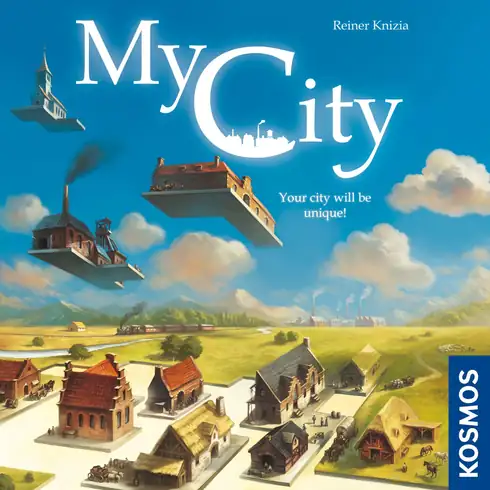
Everyone has their own board with a river, mountains and a forest, and the same 24 buildings in different shapes and three colours. A card is turned over to show the building that everyone places at the same time: the first one next to the river, each further one adjoining what is already there. At first, uncovered trees score points, while visible stones, empty spaces and passing cost points. The best-placed players record their progress by colouring it in; envelopes with new rules and stickers change the board permanently. After 24 games, whoever has made the most progress wins.
What it can help develop
Above all, the game calls for spatial reasoning: each building has to be fitted in between the river, trees and existing buildings without leaving gaps that nothing will fill later. Since the remaining buildings are on display, players can plan ahead, but the luck of the cards determines the order. The legacy format calls for cognitive flexibility: as the rules and scoring change, so does the best strategy. When pieces do not fit, players have to weigh things up: build over a tree, pass or end their own game?
Especially suitable for
- Children from age 10 who enjoy fitting shapes together
- Regular groups who want to experience a story
- Newcomers to legacy games: the rules grow step by step
Less suitable for
- Changing groups: the campaign thrives on a fixed group
- Children who cope badly with bad luck in the cards
Our verdict
My City is a worthwhile choice for regular groups of family or friends from age 10 who want to experience a story over 24 short games as an introduction to legacy games. The rules grow step by step, and the difficulty rises gently. In 2020, it was nominated for the Spiel des Jahres. Its limitations are the luck of the draw and a campaign that can only be played once.
Getting started
- At the start, there are only a few scoring rules to remember: uncovered trees count plus 1, while stones, unused spaces and passing lead to deductions.
- If no piece fits any more, players may end their own game without a penalty; passing, by contrast, costs one point.
In detail
Variants and player count
According to Kosmos, the game includes 4 boards that can be used on both sides, 96 building tiles, 24 cards and 8 sealed envelopes. There are 24 games in 8 chapters of 3 each; stickers change the board permanently, and the reverse side offers a version that can be played again and again. According to the rules, a building card is turned over and everyone places at the same time on their own board: the first building next to the river, further ones adjoining it. According to the rules, a chapter takes about 90 minutes, and the game is at its most appealing with a fixed group.
What reviewers say
The Spiel des Jahres jury lists My City among the 2020 nominees and mentions an accessible core and a gently rising level of difficulty. Opinionated Gamers calls it easy to learn, with short games; according to the review, the rules grow in small steps and become somewhat more complex towards the end. The A.V. Club counts it among the most family-friendly legacy titles, with rules that are added step by step. Meeple Mountain recommends it as a first legacy game, but found it too easy; the review sees a dependence on the luck of the draw and advises against the perpetual version. The Fandomentals calls it a family-oriented legacy game for newcomers to legacy games, with short episodes; according to the review, it gets confusing if the same group does not play all the way through. What’s Eric Playing describes how players adapt their strategy to the new elements in each chapter and have to improvise their plan because of luck in the order of the cards.
How it compares
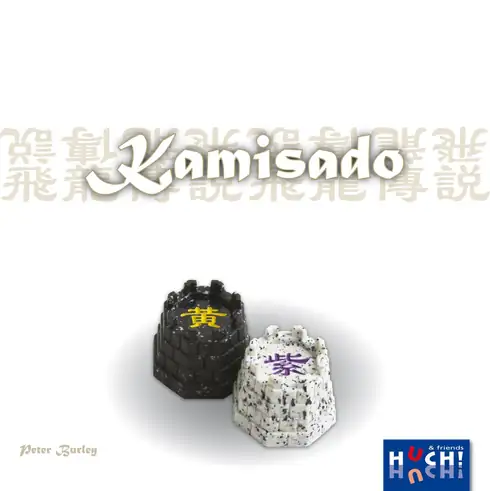
In the catalogue, My City (from age 10, 2 to 4 people, about 30 minutes) is listed under logic and planning. Imhotep (from age 10, 2 to 4 people, about 40 minutes) and Kamisado (from age 10, 2 people, about 30 minutes) are listed there too; Imhotep also shares flexibility with My City. In My City, each person builds on their own board, which changes permanently over several games. The catalogue describes Imhotep as tactical delivering with constant rivalry, and Kamisado as elegant abstract logic for two.
Sources
Frequently asked questions
What age is My City suitable for?
My City is recommended from age 10. Children who enjoy fitting shapes together and can cope when the cards drawn turn out badly are ready. The rules are easy to learn because they are added chapter by chapter.
How long does a game take and how many people can play?
A game takes about 30 minutes. The game is for 2 to 4 people, each building on their own board; whoever has made the most progress after 24 games wins.
What skills can My City help develop?
It can help develop logic and planning as well as flexibility. Each building is fitted in without creating unusable gaps, and with each chapter, new rules and scoring call for an adapted strategy.
Does My City always have to be played by the same group?
That is advisable: the campaign relies on a fixed group, and according to one review it gets confusing if the same people do not play all the way through. After the end, the reverse side of the board remains as a game that can be played again and again.