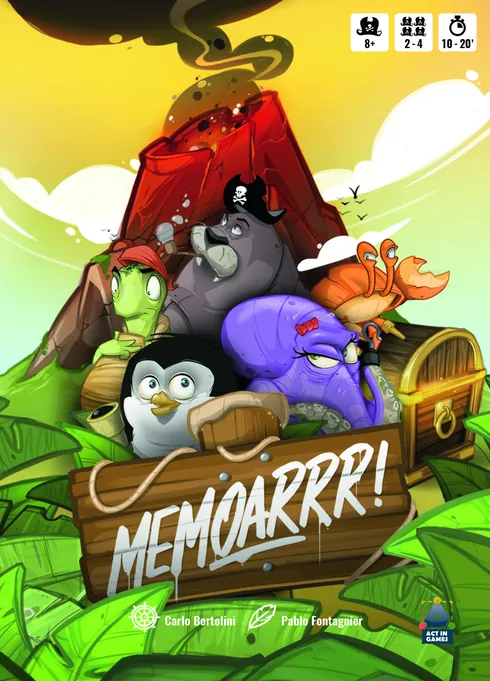
How it plays
In a 5 × 5 grid, 25 location cards (five animals in five landscapes) lie face down; the one in the middle is removed from the game unseen. At the start, each player secretly looks at the three middle cards on their side. Players take turns revealing cards; every card after the first must match the previous one: same animal or same landscape. Anyone who gets it wrong is out for the round; the last player left receives a treasure. Then all the cards are turned face down again without moving anything. After seven rounds, whoever has the most rubies wins.
What it can help develop
Above all, players need to link picture and location: where was the crab, and in which landscape? Because the cards stay where they are, this knowledge grows from round to round, provided players also follow the others’ turns. On their turn, players compare the face-up card with their constantly updated mental map: a job for working memory. Sometimes the animal matches, sometimes the landscape: this switching calls for cognitive flexibility. Tactically, players consider which card leaves the next player few safe options.
Especially suitable for
- Families who find the memory game too monotonous
- Children and adults playing together
- Short games for a spare moment
Less suitable for
- Children who find it hard to cope with being knocked out early
- Groups of frequent players looking for demanding tactics
Our verdict
Memoarrr! is a worthwhile choice for families who find the classic memory game boring and for mixed groups from age 8. The basic rules are simple, and the fixed grid makes the game more tactical as it goes on. In 2018 it won the Deutscher Kinderspielepreis and a place on the Spiel des Jahres recommendation list. Its limitations are the element of chance at the start, an early exit for some players and rather long rules.
Getting started
- To start, show the matching rule with an example: the first card of each round always succeeds; after that, the animal or the landscape must match the card revealed last.
- After each round, turn the cards back over without moving them, otherwise the knowledge gathered is lost.
In detail
Variants and player count
Sources differ on the age: the Spiel des Jahres jury gives from age 8 and notes that, from the second print run onwards, the publisher states age 6. The publisher’s page of Edition Spielwiese gives from age 8 and 10 to 20 minutes, the jury about 20 minutes. The animals on the 25 location cards are a penguin, an octopus, a walrus, a crab and a turtle; the treasure cards show 1 to 4 rubies. The expert rule adds animal actions, which may only be used after a successful turn.
What reviewers say
The Deutscher Kinderspielepreis 2018 went to this game by Carlo Bortolini, published by Edition Spielwiese and Pegasus Spiele. Ludovox writes that Memoarrr! gives memory, the matching-pairs game, a fresh twist by chaining the cards together. Board Game Quest praises the simple rules and the way the fixed grid makes the game more strategic as it goes on. According to Board Game Quest, it works well with children and is, overall, more of a family game than one for frequent players. Brettspiele-Magazin considers the basic rules very simple and the game suitable for groups of adults too. Brettspiele-Magazin is critical of the rulebook, which is unexpectedly long for a memory game, the noticeable element of chance at the start and early elimination.
How it compares
That’s not a Hat! (from age 8, 3 to 8 people, about 10 minutes), like Memoarrr!, mainly calls on memory. That’s not a Hat! suits children who love memory games and enjoy putting on a poker face, and it works as a short opener. That’s not a Hat! is less suited to anyone who is embarrassed by making mistakes in front of others. Hanabi (from age 8, 2 to 5 people, about 25 minutes) shares the age and memory with Memoarrr! (from age 8, 2 to 4 people, about 15 minutes). Cooperation as well as logic and planning are also among the skill areas of Hanabi. For two to four people who find the classic memory game too monotonous, Memoarrr! remains the obvious choice.
Sources
- Spiel des Jahres: Memoarrr! (jury, in German)
- Edition Spielwiese: Memoarrr! (publisher’s page, in German)
- Wikipedia (German): Memoarrr!
- Ultra Board Games: Memoarrr! expert rules
- Wikipedia (German): Deutscher Spiele Preis
- Ludovox: review (in French)
- Board Game Quest: review
- Brettspiele-Magazin: review (in German)
Frequently asked questions
What age is Memoarrr! suitable for?
Memoarrr! is recommended from age 8. Children who can remember locations and keep playing after mistakes are ready; anyone who finds it hard to cope with being knocked out early will enjoy it less. According to one review, the rules have sunk in after about one round.
How long does a game take and how many people can play?
A game takes about 15 minutes. The game is for 2 to 4 people, who play against each other over seven rounds; the winner is whoever has the most rubies at the end.
What skills can Memoarrr! help develop?
It can help develop memory. Because the cards stay in place, the knowledge of which animal in which landscape lay where grows from round to round; on each turn, every card is compared with this mental map.
Is Memoarrr! exciting for adults too?
Yes, reviews also consider it suitable for groups of adults, because the fixed grid makes the game increasingly tactical. Frequent players looking for demanding tactics, however, are less well served.