How it plays
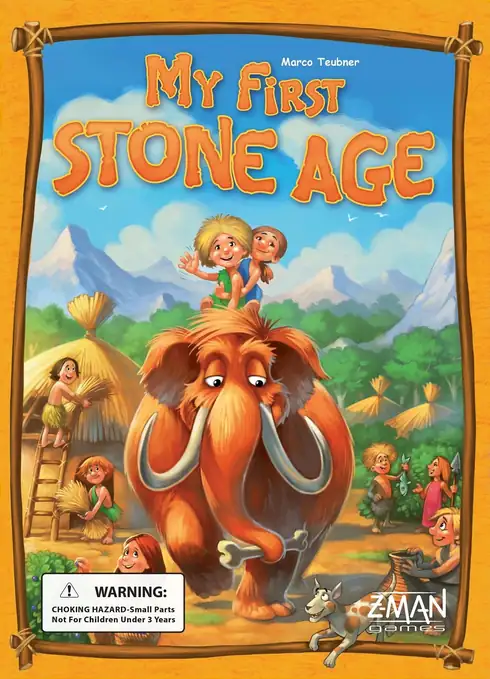
Around the board lie 14 face-down forest tiles. The active player chooses one and turns it over: dots like those on a die move the figure that many spaces, while a symbol sends it straight to the matching space. This may be a space with goods such as fish or berries, the trading space, the dog (a wild card) or the building site. At the building site, the player can build a hut by handing in the goods shown; either way, all face-up tiles are then turned face down again and two of them are swapped. Whoever has three huts first wins.
What it can help develop
At its core, it is a memory game with a goal: anyone who needs a fish has to know where the fish tile is, including from the other players’ turns. After every visit to the building site, all the tiles are face down again and two have been swapped; keeping this mental picture up to date calls on working memory. On top of this comes early planning: which hut is within reach, what is missing, are the trading space or the dog worth it?
Especially suitable for
- Children from age 5 who like collecting and building
- A first experience of collecting and trading resources
- Mixed groups in which children can keep up when it comes to memory
Less suitable for
- Children aged 8 to 10 looking for more depth
- Five-year-olds who are expected to play without adults
Our verdict
My First Stone Age, winner of the Kinderspiel des Jahres 2016, is a worthwhile choice for families who want to introduce five-year-olds, together with adults, to resources, trading and building. Because memory is at the centre, children stand a real chance against adults. Its limitations are how demanding it is for five-year-olds without support, a lot of luck at the start and little appeal for children aged 8 to 10.
Getting started
- Let everyone watch the swapping, because the rules expressly state that every player may see the two tiles.
- Make clear that building is optional: even without building a hut, a visit to the building site means that all face-up tiles are covered again and two are swapped.
- With five-year-olds, play together with an adult, because goods, trading and the wild card are demanding at this age.
In detail
Variants and player count
The designer is Marco Teubner, and the artwork is by Michael Menzel; according to Hans im Glück, the game is intended for 2 to 4 people from age 5. The rules list 14 face-down forest tiles: six with dots like those on a die and one each with a berry, fish, jug, arrowhead, tooth, trading space, dog and building site. According to BoardGameGeek, the French edition “L’Âge de Pierre Junior” was published by Filosofia Éditions and the Italian edition “Stone Age Junior” by Giochi Uniti; the age, number of players and components given above come from Hans im Glück.
What reviewers say
The jury of the Kinderspiel des Jahres 2016 praises the age-appropriate way the game handles resource management, deploying figures and building strategy, and the memory elements, which give the generations equal chances; the jury rates the demands on planning and memory as high. The game received the Essener Feder 2016 above all for its rules. Brettspiele-Magazin considers it demanding for five-year-olds because resources, trading, wild cards and memorising come together, and sees it more as a game to play with adults. One BoardGameGeek post describes movement as random at the start and increasingly determined by memory over time; in that post, the fact that children quickly grow out of the game is criticised. Another post finds it entertaining for 7- and 8-year-olds but too easy for a 12-year-old, with few real decisions; the outcome then depends above all on luck in the first tiles turned over.
How it compares
Spooky Stairs (from age 4, 2 to 4 people, about 15 minutes) shares the skill area of memory with My First Stone Age and, like My First Stone Age, calls on working memory. However, Spooky Stairs is a first memory game with figures instead of cards. Spooky Stairs is less suited to children who are looking for demanding tactics. Rat-a-Tat Cat (from age 6, 2 to 6 people, about 20 minutes) also has the skill area of memory, and in addition numbers and arithmetic. My First Stone Age adds the skill area of logic and planning to memory. My First Stone Age suits mixed groups in which children can keep up when it comes to memorising.
Sources
- Hans im Glück: rules (PDF, in German)
- Hans im Glück: Stone Age Junior (publisher’s page, in German)
- Spiel des Jahres: Stone Age Junior (jury, in German)
- Wikipedia (German): Stone Age Junior
- BoardGameGeek: Stone Age Junior (editions)
- Brettspiele-Magazin: review (in German)
- BoardGameGeek: forum post (thread 2046849)
- BoardGameGeek: forum post (thread 2695044)
Frequently asked questions
What age is My First Stone Age suitable for?
My First Stone Age is recommended from age 5, but is considered demanding for five-year-olds. A child who can remember tiles and understands goods, trading and the wild card is ready, ideally playing with an adult; for children aged 8 to 10, it lacks depth.
How long does a game take and how many people can play?
A game takes about 15 minutes. The game is for 2 to 4 people, who play against each other, and whoever is first to own three huts wins.
What skills can My First Stone Age help develop?
My First Stone Age can help develop memory as well as logic and planning. Anyone who needs fish has to know where the fish tile is, even after two tiles have been swapped, and at the same time think about which hut is within reach.
Do children stand a chance against adults?
Yes, because memory is at the centre, and swapped tiles are moved in full view of everyone. At first, there is a lot of luck involved in the first tiles turned over; later, memory has a greater influence on the outcome.