How it plays
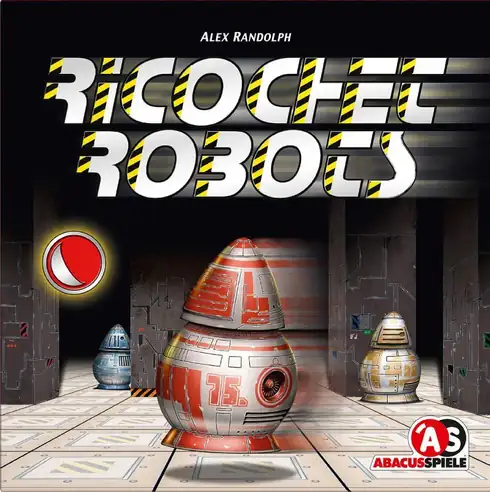
The robots stand on a board made up of four of eight sections. A token turned face up shows the target square; usually, the robot of the same colour has to get there. With no brakes, each move goes straight ahead until the next wall or the next robot. Everyone searches for the shortest route in their heads at the same time; the first bid starts the sand timer. Whoever bids the fewest moves demonstrates the route and, if successful, takes the token. The first to collect 8, 6 or 5 tokens (with 2, 3 or 4 players) wins.
What it can help develop
Every robot’s path has to be thought through spatially in advance: where does the blue robot stop if it moves left? If there is no wall at the target, another robot first has to serve as a stop. This sequence of moves has to be held in working memory until the demonstration, because the robots are only moved afterwards. Anyone who gets stuck and thinks backwards from the target needs cognitive flexibility. The sand timer demands speed; faster opponents call for frustration tolerance.
Especially suitable for
- Children from age 10 who enjoy racing to solve puzzles
- Larger groups: everyone thinks along at the same time
- Puzzling alone with the solo variant
Less suitable for
- Groups with very different thinking speeds
- Players who want to chat or relax
Our verdict
Ricochet Robots is a worthwhile choice for children from age ten who enjoy brain-teasers and for groups with similar thinking speeds in which everyone thinks along at the same time. Its strength: the rules are clear, and the board, made up of four of the eight double-sided sections, keeps producing new challenges. Its limitations are the advantage for faster players and the lack of relaxation; the game divides opinion.
Getting started
- To start, set aside the board sections with coloured diagonal barriers; the rules recommend this.
- If bids are equal, the rules decide by the order in which they were made; as a house rule to even things out, let whoever is behind on tokens demonstrate first.
- Choose a time to play when everyone is well rested, because the game takes practice and a clear head.
In detail
Variants and player count
According to the publisher, the Abacus Spiele edition includes 8 double-sided board sections, a centre piece, 5 robots, 17 target tokens and a sand timer. According to the 2013 rules, the board is made up of 4 of the 8 sections; according to Wikipedia and Reich der Spiele, this allows 1,536 variants. The first bid turns the sand timer (about 1 minute); whoever bids the fewest moves demonstrates the route and receives the token.
What reviewers say
According to Wikipedia, the first edition was published in 1999 as “Rasende Roboter” by Hans im Glück. The review on das-spielen.de (Hall9000, Kathrin and Peter Nos) says that the rules leave no questions open and that the board allows plenty of variety. According to this review, the tension is high among evenly matched players; the game needs practice and a well-rested mind and is not suitable for relaxing. Opinionated Gamers reviewed the Z-Man edition in 2014: whoever solves a little faster almost always wins, which is partly frustrating; according to the review, the game is not for everyone, but there are also enthusiastic voices. In 2001, spieletest.at called “Rasende Roboter” a very good thinking game; according to spieletest.at, there is hardly any communication, so it is not for players who like to communicate, and it can also be played alone. In 2014, Reich der Spiele reviewed the 2013 Abacus edition: the sequence of play and the rules are unchanged, and fans of brain-teasers that can be cracked quickly will enjoy it; the review uses the keyword reaction game.
How it compares
In the catalogue, Ricochet Robots (from age 10, 1 or more people, about 30 minutes) combines memory, logic and planning as well as perception and speed. Mastermind (from age 8, 2 people, about 20 to 40 minutes) shares memory as well as logic and planning. The catalogue describes Mastermind as deduction in its purest form: the aim is to crack a secret colour code. Hanabi (from age 8, 2 to 5 people, about 25 minutes) has the same two skill areas, plus cooperation: players see the other players’ cards, but not their own.
Sources
Frequently asked questions
What age is Ricochet Robots suitable for?
Ricochet Robots is recommended from age 10. A child is ready when they can play through a robot’s path in their head and are not discouraged when others reach the solution faster. Anyone who would rather chat or relax will be less happy with it.
How long does a game take and how many people can play?
A game takes about 30 minutes. The number of players starts at 1 person and is open-ended: alone with a solo variant, otherwise against each other, with everyone searching for the shortest route in their heads at once.
What skills can Ricochet Robots help develop?
Ricochet Robots can help develop memory, logic and planning as well as perception and speed. Every path is thought through spatially in advance. A whole sequence of moves, for example with a second robot as a stop at the target, has to be kept in mind until it is demonstrated.
What if someone is much faster than the others?
That is the main criticism: whoever spots the solution faster usually takes the tokens, and in unevenly matched groups that is frustrating. The game works better when everyone plays at a similar level.