How it plays
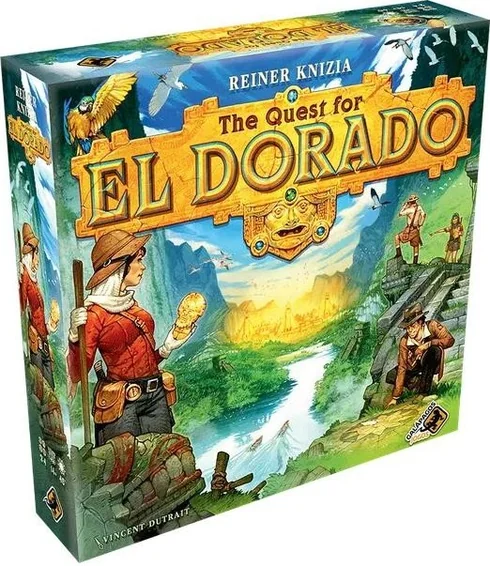
Everyone starts with eight basic cards, four of them in hand. Players use them to move their figure across a variable board: jungle requires machetes, water requires paddles and villages require coins. For each space, a single card with the matching symbol and enough strength counts. With the remaining cards, players buy at most one new card from the market, which only comes into their hand after shuffling. Whoever reaches El Dorado triggers the final round; if several players arrive, whoever has overcome the most blockades wins.
What it can help develop
Above all, planning ahead is required: which route suits a player’s own deck, and which card is missing for the stretch of water further ahead? Delayed gratification, one aspect of impulse control, comes in too: anyone who uses cards for buying rather than moving briefly gives up ground but usually makes faster progress later. Because every hand turns out differently and other players’ figures block spaces, plans have to be adjusted constantly, which calls for cognitive flexibility.
Especially suitable for
- Children from age 10 who are discovering strategy games
- Families who want to get into deck-building
- Two players: each person controls two figures
Less suitable for
- Impatient children: the start is slow
- Small tables: the board and market need space
Our verdict
The Quest for El Dorado is a worthwhile choice for families with children from age 10 who want to try deck-building for the first time. The jury praised the intuitive combination of deck-building and racing, and in 2017 the game was nominated for the Spiel des Jahres. Its limitations are that the theme feels tacked on, the start drags, the luck of the draw plays a part and the board and market take up a lot of table space.
Getting started
- Clear a large table beforehand, because the board and market take up a lot of space.
- Make clear right at the start that only a single card counts per space; cards cannot be combined.
- Remind everyone that occupied spaces are blocked, so the other players’ figures are part of each player’s own planning.
In detail
Variants and player count
The fact that each person controls two figures in a two-player game has a consequence: according to the rules summary from UltraBoardGames, both figures then have to reach El Dorado. Ravensburger describes the game as particularly good for two. The board is variable, and the current edition contains 36 cave tiles for the cave variant. According to Wikipedia, cards can also be removed from the game. Brettspielbox points out that the luck of the draw can be reduced by thinning out the deck.
What reviewers say
In the Spiel des Jahres 2017, The Quest for El Dorado was on the nomination list alongside Magic Maze; the winner was Kingdomino. Brettspielbox calls it a great family game and describes the dilemma of either moving forward quickly or strengthening your own team. Reich der Spiele reports two camps: frequent players had little interest in repeating it after a few games, while family groups wanted to play again straight away. The same review found progress laborious at first and missed more soul in the theme. Shut Up & Sit Down praises a solid, simple and clean design.
How it compares
Karuba (from age 8, 2 to 4 people, about 30 to 40 minutes) shares with The Quest for El Dorado the skill areas of logic and planning as well as flexibility. Karuba already suits children from age 8 who enjoy brain-teasers and families who want to play without direct conflict. Karuba is less suited to groups looking for interaction and annoying each other. Istanbul (from age 10, 2 to 5 people, about 40 to 60 minutes) also calls for planning ahead and is aimed at families with gaming experience who are looking for something trickier. With two players, Istanbul is less suitable if interaction matters. The Quest for El Dorado, by contrast, works well with two.
Sources
- UltraBoardGames: rules summary
- Wikipedia (German): Wettlauf nach El Dorado
- Ravensburger: Wettlauf nach El Dorado (publisher’s page, in German)
- Brettspielbox: review (in German)
- Wikipedia (German): Spiel des Jahres
- luding.org: Wettlauf nach El Dorado (in German)
- Reich der Spiele: review (in German)
- Shut Up & Sit Down: review
Frequently asked questions
What age is The Quest for El Dorado suitable for?
The recommended minimum age is 10. Children who enjoy planning ahead and are willing to try their hand at strategy are ready. Impatient children find the slow start harder.
How long does a game take and how many people can play?
A game takes about 45 to 60 minutes. The game is for 2 to 4 people, who play against each other in a race to the finish; with two players, each person controls two figures. Whoever reaches El Dorado triggers the final round.
What skills can The Quest for El Dorado help develop?
It can help develop logic and planning as well as flexibility. Players have to consider which route suits their own deck, and because other players’ figures occupy spaces, plans have to be adjusted again and again.
Do you need to be familiar with deck-building?
No. One review describes it as deck-building without the complexity of Dominion: players start with eight basic cards and buy at most one new card per turn.