How it plays
The challenge card in the slot of the 5 × 5 grid shows which pieces are fixed; for some of them, only the orientation is open. Players add further pieces themselves, such as beam splitters or double-mirrors, and have to use them all. The beam must light up exactly the required number of targets and touch every piece except the cell blocker. Then the player presses the laser button; the only solution is on the back of the card.
What it can help develop
In the air, the beam is invisible; only its dot on the pieces can be seen, and the path in between has to be imagined. Where does a mirror send the beam if it faces one way or the other? This calls for spatial reasoning and thinking ahead. An exact number of targets, every piece hit: such requirements rule out many arrangements, which calls for logical reasoning. When a beam splitter divides the beam, two paths have to be kept in working memory at the same time.
Especially suitable for
- Children from age 8 who like tinkering and are interested in technology
- First experiences with light and mirrors
- Teenagers and adults who enjoy puzzling things out alone
Less suitable for
- Social groups: it is a solo puzzle game
- Children who give up quickly when they cannot find a mistake
Our verdict
Laser Maze is a worthwhile choice for children from age 8 who like tinkering and for adults who prefer to puzzle over things alone. The technology is convincing, and every challenge solved makes players want more. Its limitations are the solo format, the barely visible beam, which makes finding errors harder, and a somewhat uneven level of difficulty across the cards.
Getting started
- Start with a card from the Beginner level: the challenges are divided into four levels, up to Expert.
- If an error in the beam’s path cannot be found, look at the back of the card, where the only correct solution is given.
- Consecutive cards can look almost the same and yet have completely different solutions, so do not simply carry over the previous solution.
In detail
Variants and player count
Laser Maze by ThinkFun is for 1 person from age 8. The box contains challenge cards with solutions in four levels, from Beginner to Expert. There are also eleven pieces: a laser, two beam splitters, a double-mirror, a cell blocker, five targets and a checkpoint. A challenge is solved when exactly the required number of targets light up and the beam touches every piece except the cell blocker; the only correct solution is on the back of the card. The laser is Class 1, but according to the instructions, players should still not look into the beam.
What reviewers say
ASTRA, the US association of specialist toy retailers, gave Laser Maze a “Best Toys for Kids” award in the Game Play (8+) category in 2013, and it was nominated for the Toy of the Year Awards 2014. In 2013, GeekDad noted that in reality the beam cannot be seen, only the points where it hits, and that after many deflections the dot is no longer centred. Fjelfras praises how strongly the game invites play and the sturdy components. However, Fjelfras reports that with a long beam path the target sometimes did not light up despite a correct solution, and that children were disappointed that the beam is not visible. Hall9000 notes that the pieces fit perfectly into the recesses and that the technology works flawlessly, and advises explaining the dangers of the laser beam to children beforehand.
How it compares
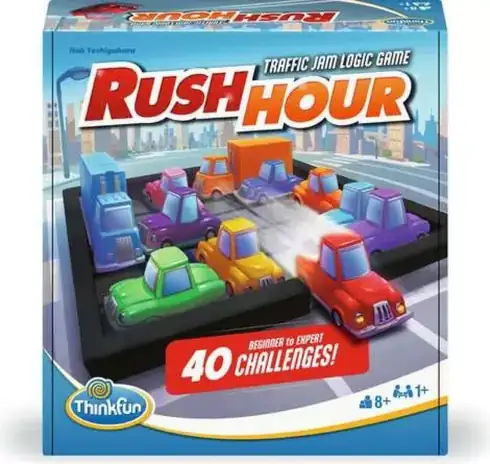
Rush Hour (from age 8, 1 person, flexible playing time) is, like Laser Maze, a solo puzzle game from age 8. In Rush Hour, the focus is on planning ahead, cognitive flexibility as well as patience and perseverance; in Laser Maze, it is on spatial reasoning, logical deduction and working memory. Mastermind (from age 8, 2 people, about 20 to 40 minutes), like Laser Maze, calls on working memory and drawing conclusions from given information. However, Mastermind is played as a duel for two, for example between a parent and a child. Children who are easily discouraged are less well served by Laser Maze and by Mastermind: by Laser Maze when a mistake cannot be found, by Mastermind after many failed attempts.
Sources
- ThinkFun: Laser Maze instructions (PDF)
- ThinkFun: Laser Maze (publisher’s page)
- ThinkFun Benelux: Laser Maze (publisher’s page, in French)
- ThinkFun: Laser Maze instructions 76340 (PDF, multilingual)
- ASTRA: Best Toys for Kids 2013
- Toy Industry Association: Toy of the Year 2014 nominees
- GeekDad: review, 2013
- fjelfras: review (in German)
- Hall9000: review (in German)
Frequently asked questions
What age is Laser Maze suitable for?
Laser Maze is recommended from age 8. It suits children who like experimenting, are interested in technology and do not give up straight away when a mistake cannot be found. It is less suitable for children who are easily discouraged.
How long does a game take and how many people can play?
Laser Maze is a puzzle game for 1 person. The playing time is flexible, because the challenge cards (60 in the edition reviewed), in four levels, are solved one at a time, at the player’s own pace.
What skills can Laser Maze help develop?
It can help develop logic and planning above all. The path of the beam via mirrors and beam splitters has to be worked through mentally and checked against the requirements on the card, such as the exact number of targets.
Is the laser dangerous for children?
According to the instructions, the laser is Class 1, but players should still not look into the beam. Several reviews advise explaining the laser to children beforehand.